Introduction
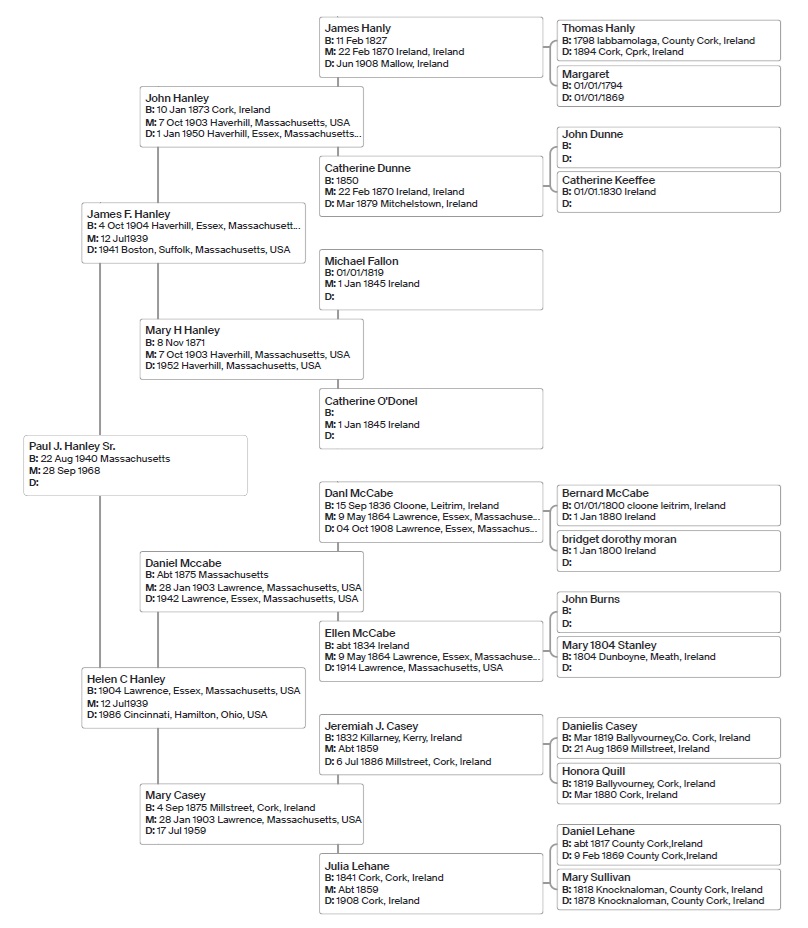
The McCabe Casey Hanley Family Tree
The McCabe Family
 |
|
Acknowledgement
Wife Paula and cousins
All rights reserved. No part of this research information may be reproduced in any form or by any electronic or mechanical means including storage and retrieval systems without permission in writing from Paul J. Hanley Sr.
Contact
email: mccabefamres@gmail.com
|
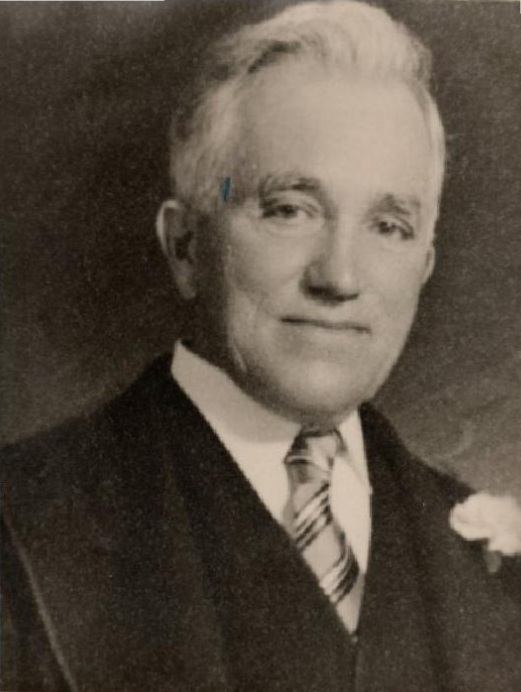 In Memorium Daniel McCabe 1875 - 1942 |
| It was my great misfortune to never know my grandfather. He was a great family man. I would have liked him, I certainly respect him. Paul J. Hanley Sr. April 1, 2023 |
Oh, Ireland must we leave you driven by a tyrant's hand And seek a mother's blessing from a strange and distant land Where the cruel cross of England shall never more be seen And in that land, we'll live and die still wearing Ireland's green |
|
The Wearing of the Green 19th century Irish street ballad Several authors, many verses |
|
In the nineteenth century my ancestors left Ireland for the promise of a better life in America Ellen Burns, Daniel McCabe, Mary Fallon, John Hanley and Mary Casey traveled across the Atlantic in the "immigrant Ships". None of the five ever saw Ireland again. These pictures, letters, documents, some more than one hundred years old have been moved from household to household through four generations. I wanted to weave these sources into a story of my family. Much of the history lies in the stories I heard as a boy. Without the oral history passed down by my mom, my aunts, Agnes and Claire, and my uncle Bernard, this presentation would not have been possible. Credit goes to my wife and my cousins who have supported this effort. I should note also the exceptional contributions of Timeline Research Ltd, our consulting genealogists based in Dublin Ireland. I have also borrowed liberally from the resources of the Lawrence MA Historical Society. |
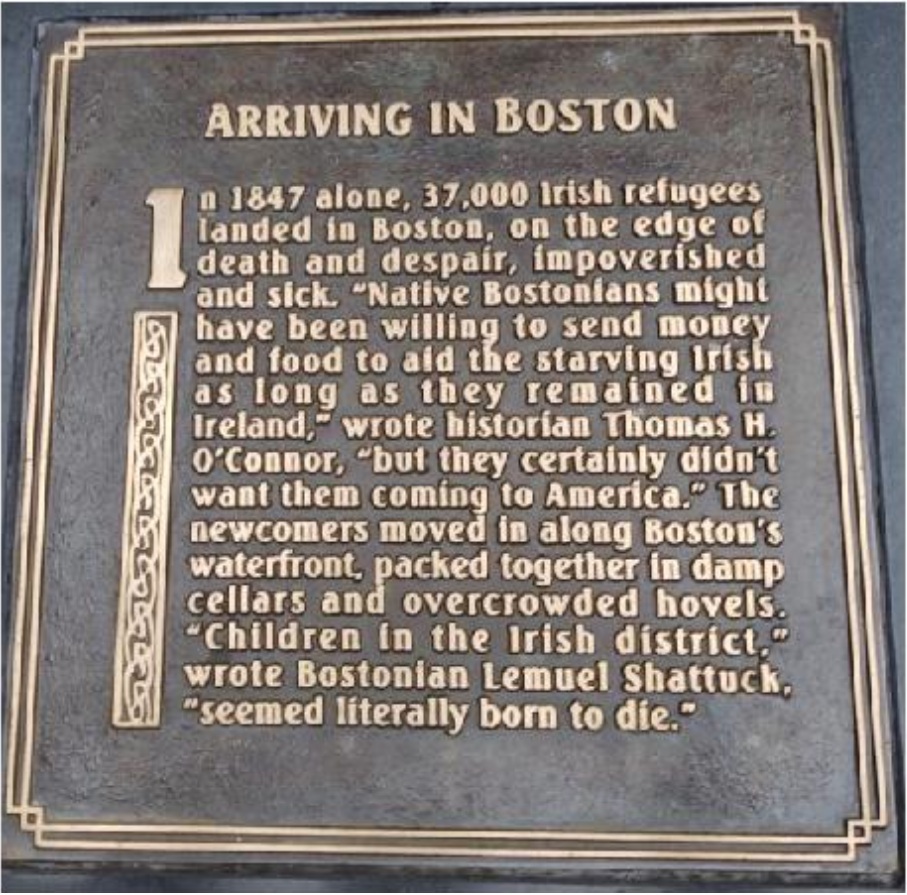 |
This plaque is part of the Irish Famine Memorial which was installed in Boston in 1998. The Irish Famine Memorial has been the subject of significant controversy. Source: Wikipedia: Boston Irish Famine Memorial |
The Irish Potato Famine also known as the Great Hunger began in 1845 and lasted until 1852. An estimated one million Irish men and women died of hunger and disease during this period. Another one million left Ireland and sought refuge in other countries. During the Famine, the population of Ireland declined by 25%.
The Famine is the likely explanation for my great grandmother Ellen Burns (1834-1914) emigrating. She sailed from Liverpool on the ship "Equity" and arrived in Boston on May 9, 1850. She was 16 years old.
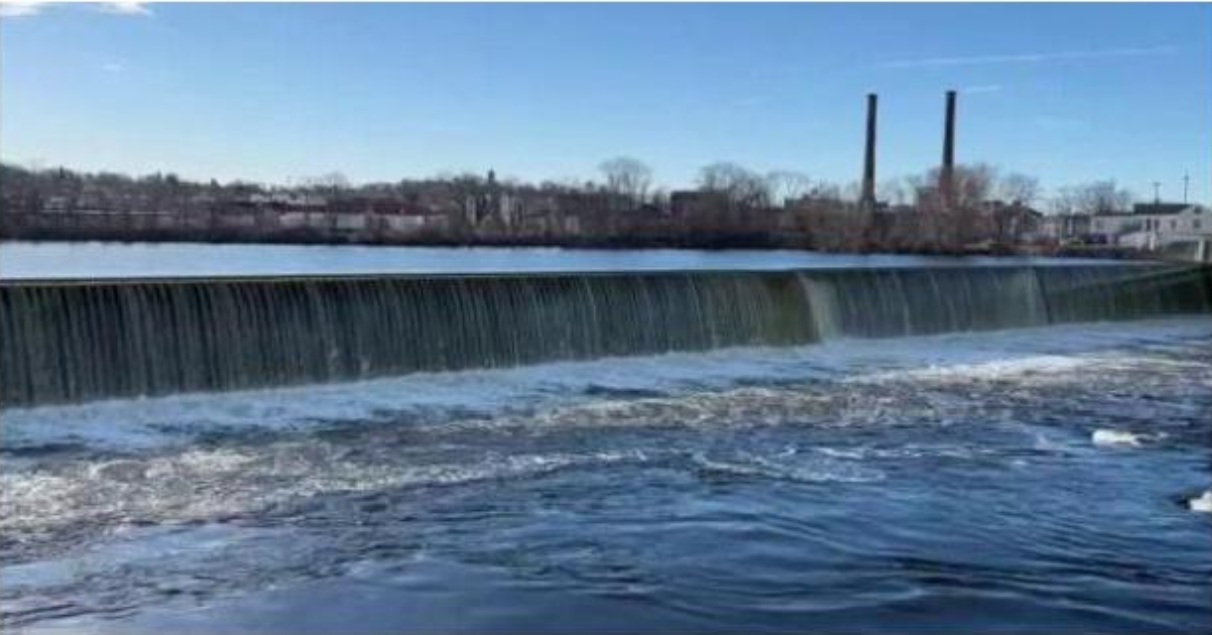 |
This is the Great Stone Dam at Lawrence, Massachusetts. Built during the period 1845-1848, primarily by Irish laborers from, County Cork. At the time of its construction, it was the largest dam in the world. |
At the same time that the Famine was occurring in Ireland, businessmen and engineers were building dams on the Merrimack River to harness its' waterpower. Abbot Lawrence, a Boston entrepreneur and his partners embarked on a bold plan to build a dam on the site of Bodwell's Falls on the Merrimack River at what would become Lawrence Massachusetts, named for Abbot Lawrence. Mr. Lawrence and his partners purchased land from the communities of Andover, North Andover and Methuen to create the city.
After the dam was finished, Lawrence became a textile powerhouse fueled by waterpower and European immigrant labor. By 1900, the Lawrence mills were some of the largest in the world employing thousands of immigrants willing to work for low pay and endure harsh conditions.
By the late 1800s, giant textile mills stretched for a mile along the banks of the Merrimack at Lawrence. "Less than 40 years after the Essex Company’s incorporation, 338,100 spindles, 9,057 looms, and 10,200 employees weaved two million yards of worsted a week. The Lawrence Machine Shop, built between 1846 and 1848, constructed most of the machinery used in the mills and also for a time, built railroad locomotives."
Abbot Lawrence, his partners and the other mill owners of the Merrimack River valley became very wealthy. As time went by working conditions in the mills deteriorated. The Irish girls who fled the Famine and other European immigrants found themselves trapped in an oppressive labor system. In 1912 there was a general strike Bread and Roses. The strike was a watershed moment in American labor history.
Ellen Burns was listed in the 1860 US Census as a servant, she avoided the millwork. Ellen would later meet Daniel McCabe another Irish immigrant and they would marry and have several children. The Irish "servant girl" who could neither read nor write would live to see three grandsons graduate from Boston College one of whom would become a priest and later be elevated to the rank of Monsignor.
Recommended reading: Wikipedia: Great Stone Dam; 1912 Lawrence Textile Strike
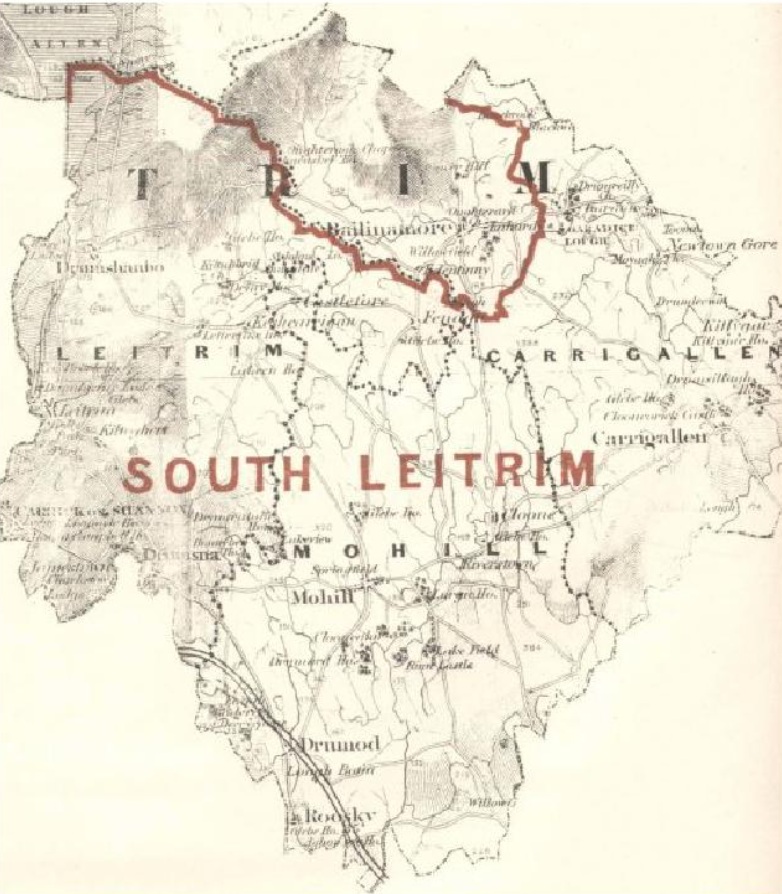 |
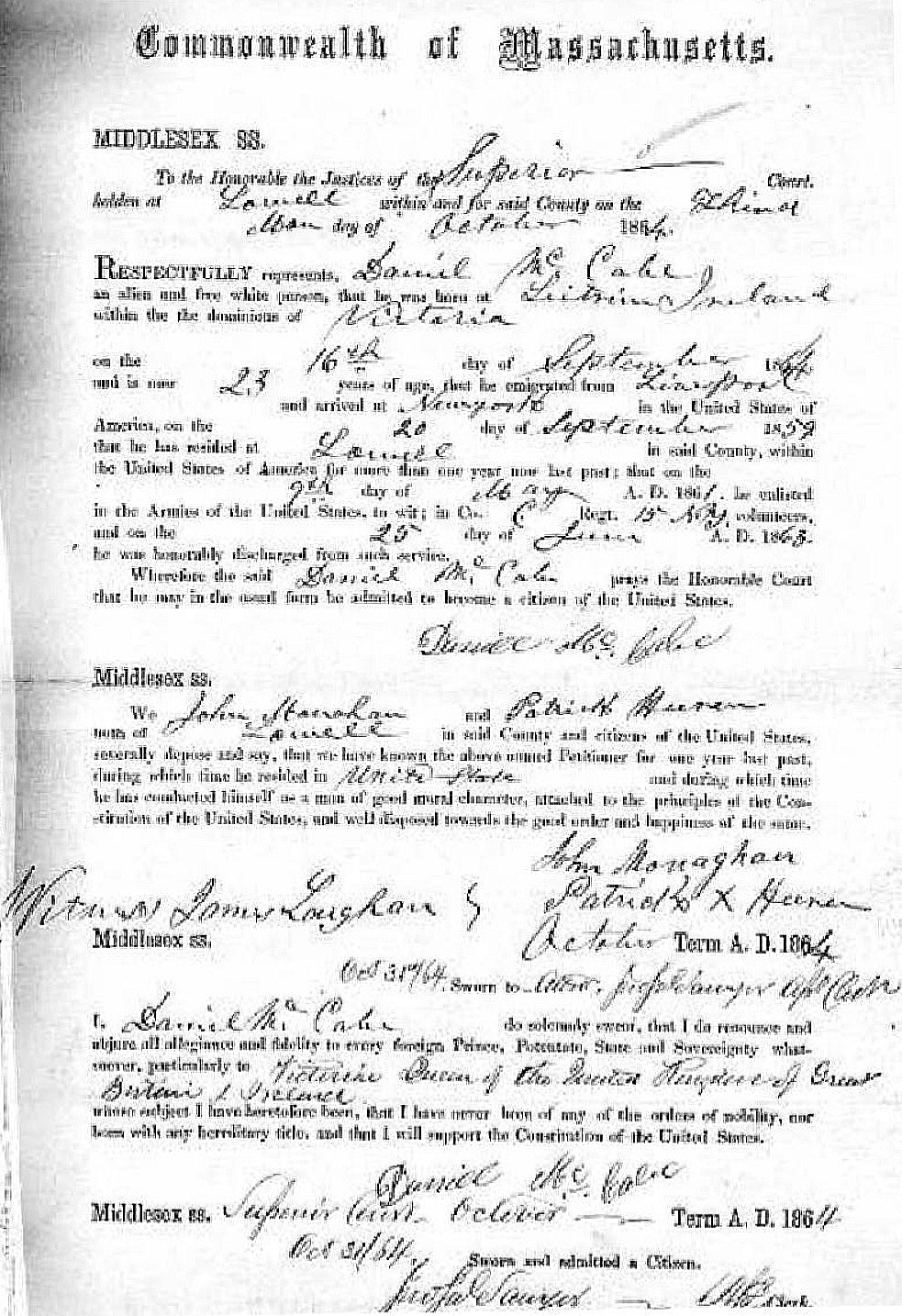
My great grandfather Daniel McCabe (1836-1908) arrived in New York on September 20, 1859, sailing from Liverpool. In 1864 when he applied for citizenship Daniel stated that he was 23 years old, corresponding to a birth year of 1841, that his parents were Bernard and Bridget and that he was born in Leitrim. My research into Daniels's life has raised questions about Daniel's birth year and his parentage. When he passed in 1908, his death certificate stated that he was 70 years old which corresponds to the birth year 1838 inscribed on the family headstone in Lowell MA. |
|
Research Results Daniel McCabe was baptised on 15th September 1836 in the Roman Catholic parish of Cloon, Co. Leitrim the son of Bernard McCabe and Dorothy Moran. A Search was made of the baptismal register for the Roman Catholic parish of Cloone, for the baptisms of the children of Bernard McCabe and Dorothy Moran or Bridget _____, Excluding the baptism of Daniel, the search identified transcribed records of the following baptisms. Baptised at the Roman Catholic parish of Cloone on 5th July 1823, Anne daughter of Bernard McCabe of Racullen and Bridget Moran. Baptised at the Roman Catholic parish of Cloone on 25th September 1825, Alexander son of Bernard McCabe of Racullen, and Bridget Moran. Currently the parish register for the Roman Catholic parish of Cloone is digitised online from 1st February 1820 to the 12th March 1820 and 1st January 1834 to 5th February 1881 with some gaps. However, the Leitrim Genealogy Centre have transcribed earlier sections of the baptismal register and these transcriptions have been published online by the Irish Family History Foundation. The above entries have not been verified by inspection of the original register. |
After many months and countless hours of fruitless searches I decided to engage a professional genealogy group to research my Irish ancestors. There are many problems with accessing and searching 19th century Irish records including the many errors in the recording and transcribing of data, wrong name, wrong date etc. and there are gaps in the records. Engaging a professional genealogy group turned out to be a wise decision |
| Source: Report on the McCabeFamily, 2nd August 2024, Timeline Genealogy in Ireland |
|
Marriage of Bernard McCabe and Bridget/Dorothy Moran Bernard and his wife Bridget/Dorothy were having children from as early as 1823 and possibly earlier. If this couple were residing in the civil parish of Cloone at the time of their marriage, it is likely they were married in the Roman Catholic parish of Aughavas, Cloone Conmaicne or Gortletteragh. The marriage register for the Roman Catholic parish of Aughavas is available from 1845, 1823 for the Roman Catholick parish of Cloone Conmaicne and 1826 for the Roman Catholic parish of Gortletteragh. If Bernard McCabe and Dorothy/Bridget Moran were married in the Roman Catholic parishes of Aughavas or Gortletteragh then their marriage record does not survive. If this couple were married in the Roman Catholic parish of Cloone Conmaicne prior to 1823 then we will not find a record of their marriage. Nonetheless, a search was made of the marriage register for the Roman Catholic parish of Cloone Conmaicne for evidence of the marriage Bernard McCabe and Bridget or Dorothy Moran. The search returned no results. |
| Source: Report on the McCabe Family, 2nd August 2024, Timeline Genealogy in Ireland Our researchers were able to find the birth record for Daniel McCabe and they also found records for the births of two children born to Bernard and Bridget who were siblings of Daniel. The researchers were also able to provide a plausible explanation for the lack of a marriage record for Bernard and Bridget. |
| The Cromwellian conquest of Ireland in the middle of the 17th century began a period of devastating colonial rule that lasted until the 20th century. The English ruled Ireland in a most cruel fashion hence the phrase "the cruel cross of England" in the street ballad "The Wearing of the Green". The English denied basic civil rights, sought to eradicate the Irish language, denied political representation, restricted education and suppressed the Roman Catholic religion. The Irish Catholic farmers were forced to pay a tithe to support the Church of Ireland. Cruelest of all was the callous indifference of English leaders who failed to respond to the suffering of the Irish people during the Famine In the early 1800s Bernard McCabe was a tenant farmer in the Townland of Racullan, in the Civil Parish of Cloone, in County Leitrim. His landlord was Colonel Madden. The Madden family owned several thousand acres in both County Monaghan and County Leitrim. In 19th century Ireland ownership of agricultural land was concentrated in the hands of less than a thousand families. Fortunately for our purposes the Madden estate managers kept detailed records of the Madden properties, and we have documentation linking Bernard to particular leases in Racullan. |
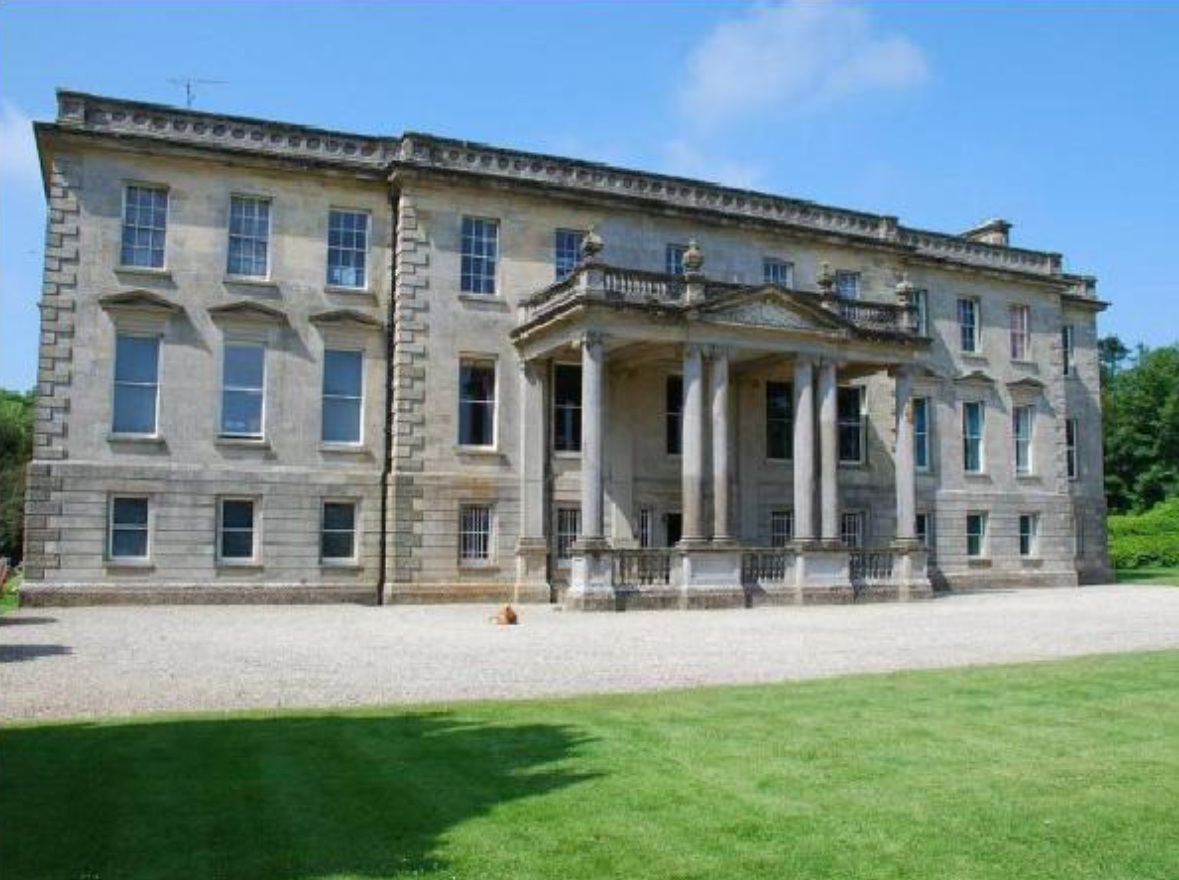 |
Hilton Park, the Madden manor house in County Monaghan, was first built in 1734. It was destroyed by fire in 1803 and was slowly rebuilt over 15 years. There have been many renovations over the years. The great country houses of Ireland, some of which still exist were built by ultra rich landowners like the Madden family. |
Today Ireland is free, the landlord tenant system is in the past and the Madden House is a boutique hotel, a wedding venue and a conference center and its function is totally transformed from the days when the Lord of the manor was truly the Lord of the manor. Current pictures suggest that the house and gardens have been beautifully maintained.
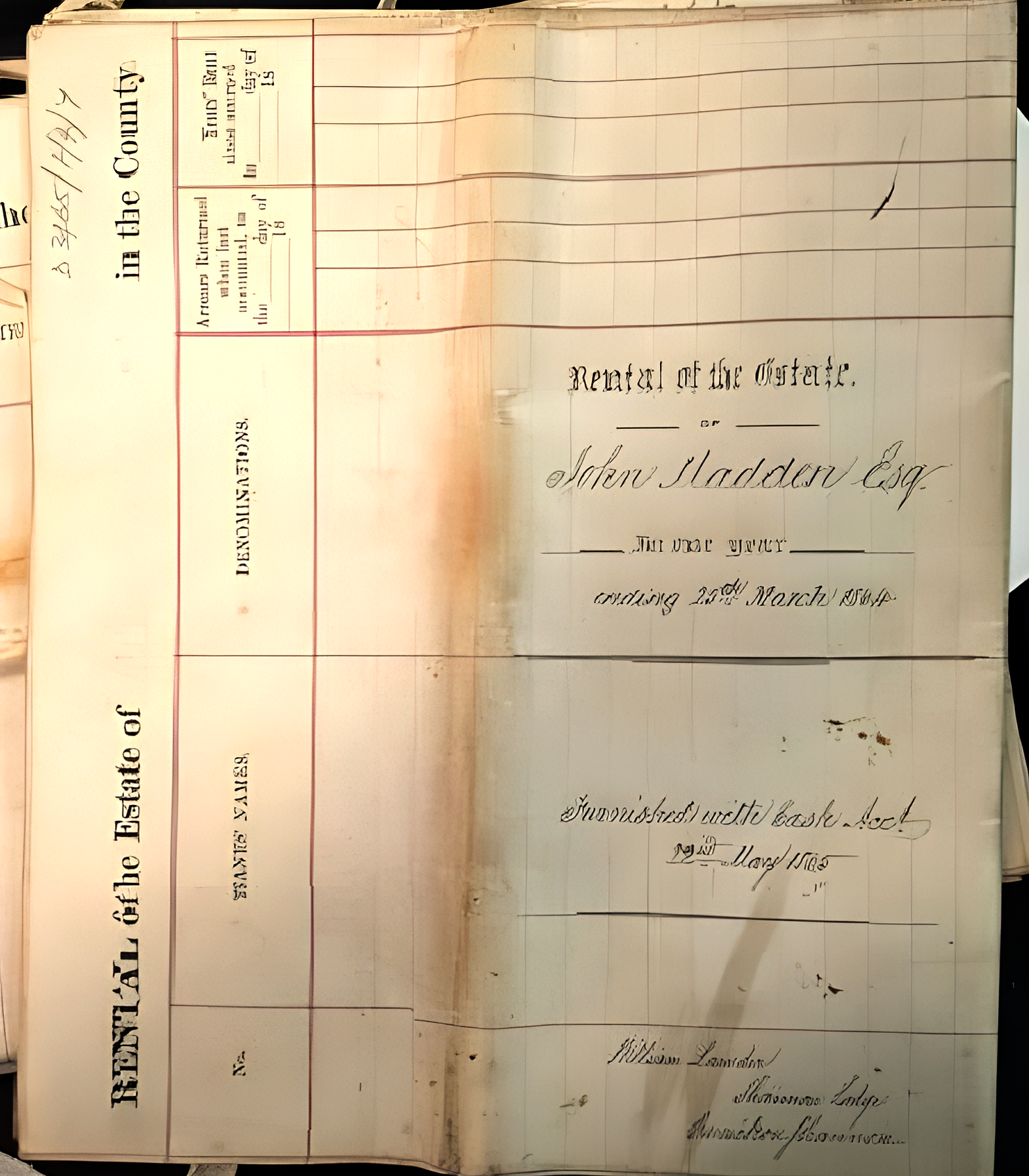 |
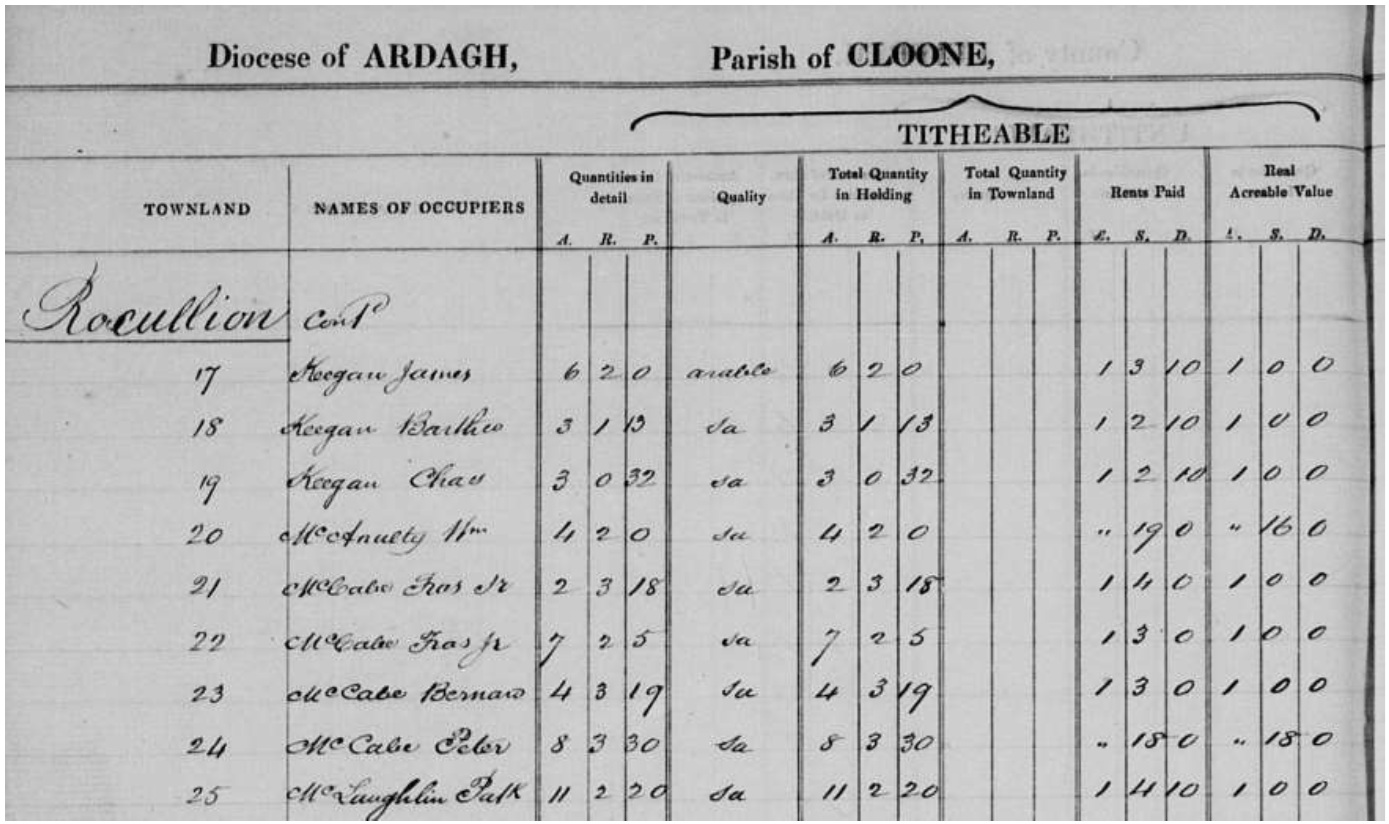
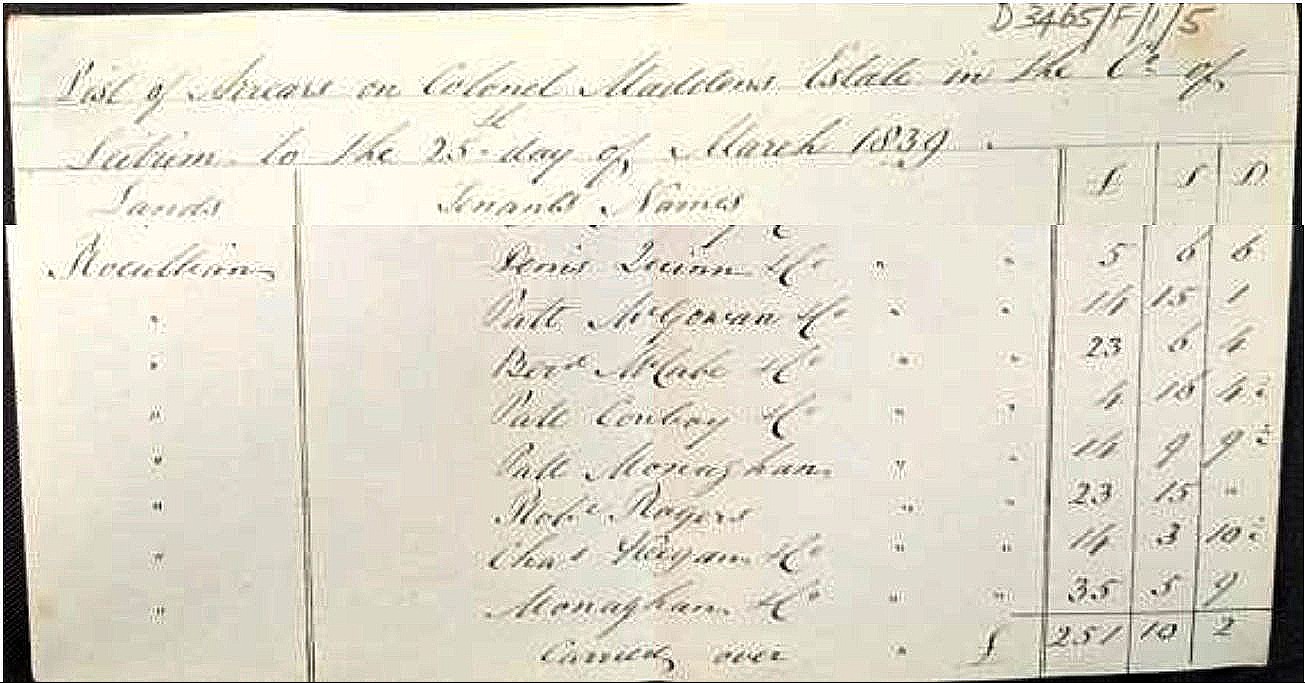
Our consulting genealogist researched the Madden Estate Papers in the Public Records Office of Northern Ireland (PRONI). Records in the Madden papers show that for the period 1831 to 1839 Bernard McCabe was a tenant on the Madden property. Together with the Tithe Valuation of 1827, we have documentation that Bernard McCabe was resident in Racullen in the 1820s and 18303s. Before and after that, we know very little. We have no record of his birth or death. Evidence suggests that Bernard had several children and that he had siblings and cousins. There is evidence that many McCabes continued to live in Leitrim after Bernard no longer appeared in the documents, but we don't know what became of those McCabes. |
| Tithe Applotment Books: Bernard McCabe Racullen, 1827. The Tithe was a tax which was levied to support the established church, the Church of Ireland. The tax was particularly onerous to the Irish Catholic population. |
Source: Report on the McCabe Family, 2nd August 2024, Timeline Genealogy in Ireland |
Source: Report on the McCabe Family, 2nd August 2024, Timeline Genealogy in Ireland |
This document is titled "Arrears on Colonel Maddens Estate in the County of Leitrim". It is dated 25th day of March 1839. Per the document, Bernard was behind on his rent as were many other tenants on adjacent plots. It was a hard life. This is the last record we have for Bernard on the Madden Estates. |
| I have not been able to find a record of the birth or death of Bernard or Bridget. The evidence we have suggests that Francis McCabe Sr. was his father. Bernard was likely buried close to his residency in the old St. Marys cemetery pictured at the right. | 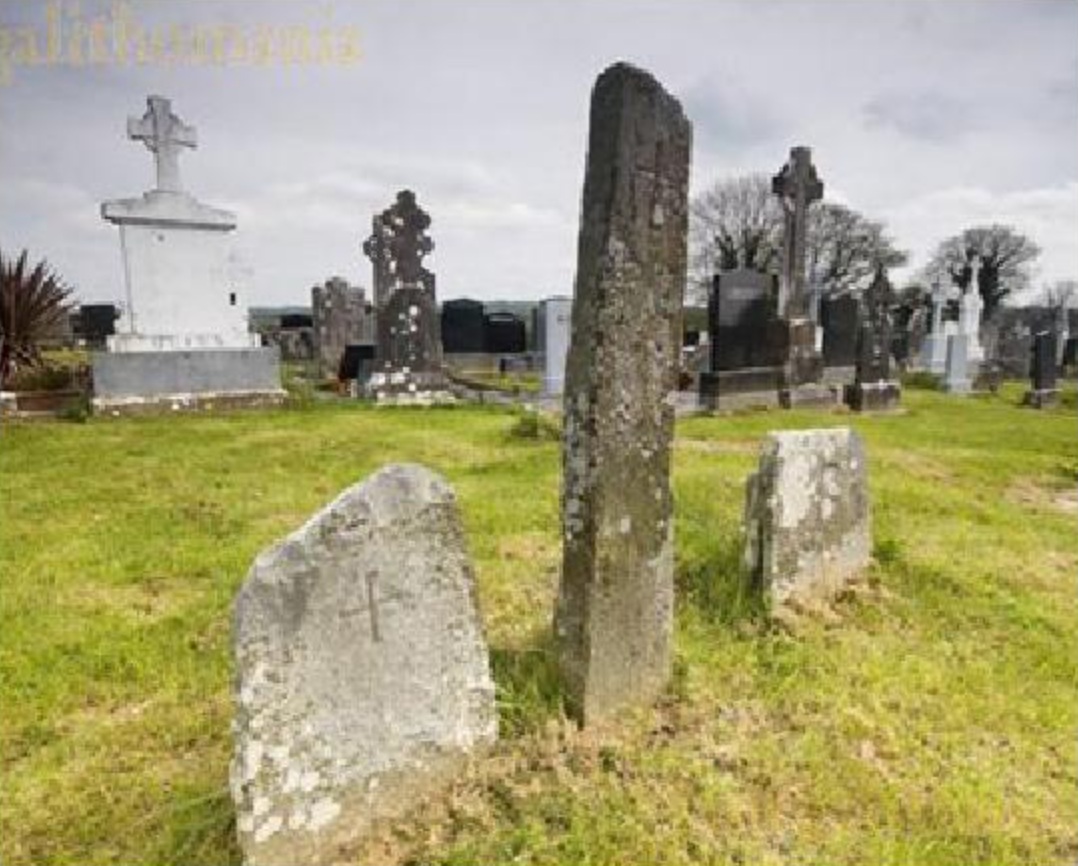 |
Land records suggest that Bernard McCabe had died or left Racullen by 1857 and it is possible that his property passed to Terence McCabe, a possible sibling, or the property passed out of the McCabe family entirely, or to Francis or Peter McCabe. There were certainly descendants of the various McCabe families of Racullen still residing in the townland by the start of the 20th century. | |
Source: Report on the McCabe Family, 2nd August 2024, Timeline Genealogy in Ireland | |
Why did Daniel McCabe choose to leave Ireland? There could be many reasons; his parents died, and he was not close to his siblings, the grinding poverty, the Famine (Daniel had grown up during the Famine and was likely deeply affected by that experience), the landlord/tenant system was unbearable, the English rulers were tyrants or perhaps he was an adventurous soul who wanted to explore the world beyond Leitrim. To the best of my knowledge, Daniel had no contact with his Irish family after he emigrated, nor did he leave a diary or other written records which would document the McCabe history in Ireland. Nothing is known of Daniel's life in New York for the first 19 months after he arrived from Ireland but in May of 1861, he enlisted in the 15th NY Engineers Regiment and two years later when he was discharged, he moved to Lowell MA. We have no record of what motivated Daniel to volunteer for military service. The ranks of the New York units were filled with thousands of newly arrived Irish men and military service was a way of gaining acceptance in a society which was very hostile to the Irish Catholic immigrants. An estimated 150,000 Irishmen served in the Union forces.
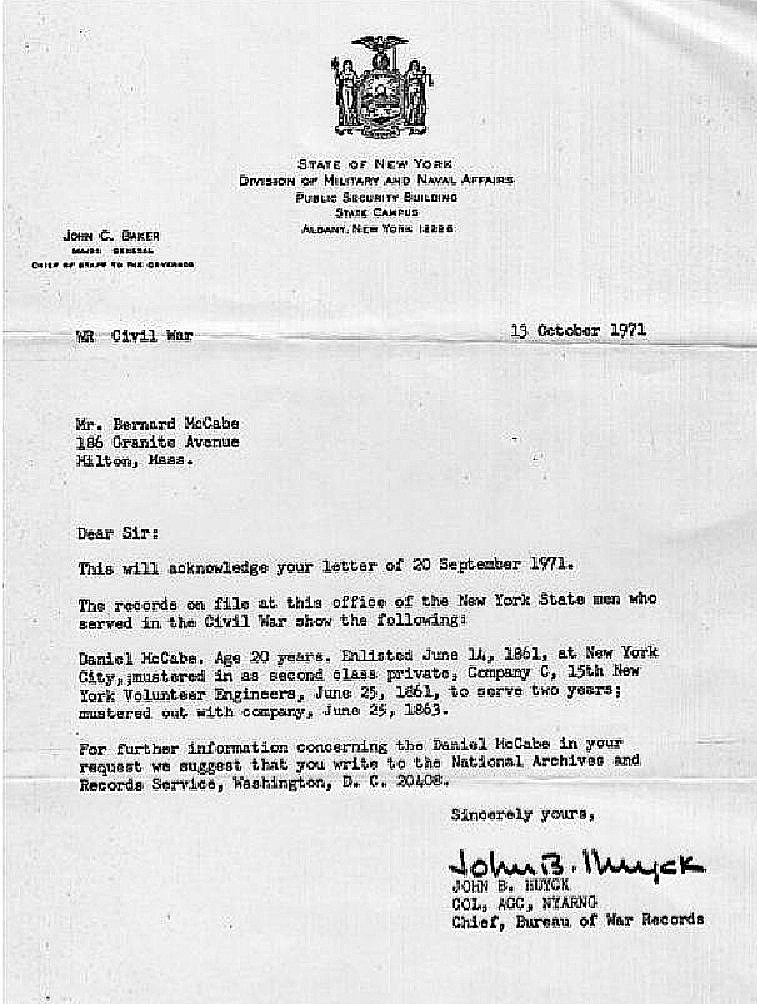 Daniel McCabe served two years with the 15th NY Engineer Regiment | 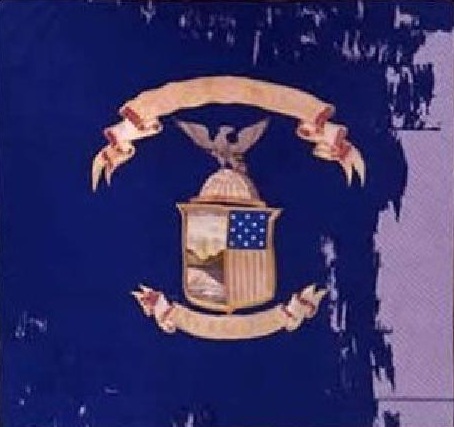 Regimental Colors of the 15th NY Engineers |
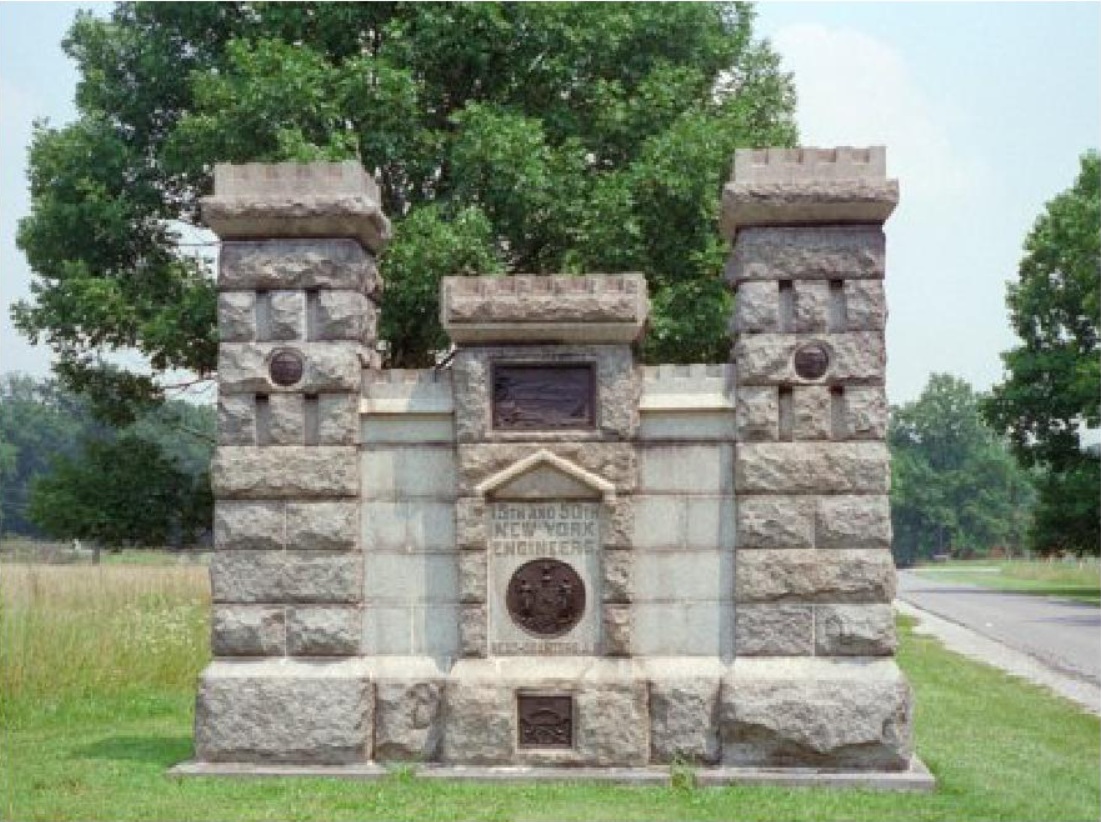
15th New York Engineer Monument at Gettysburg
After he was discharged from military service, Daniel moved to Lowell MA. Why he chose to go to Lowell is again a mystery. Daniel met Ellen Burns and Daniel and Ellen were married in St Marys Church in Lawrence MA on May 9, 1864. They would go on to have six children, James (1865-1869), Bernard (1865-1934), Mary Ellen (1866-1952), John (1869-1950), Maggie (1873-1873) and Daniel (1875-1942). Their sixth child, Daniel (Dan), was my grandfather.
Daniel's application for US Citizenship is shown in the image directly below these paragraphs.
The 1870 census shows the family living in Lowell MA and Dan's occupation is listed as laborer.
In the 1880 census, the family is listed as residing at 328 Common St in Lawrence, MA. Dan's occupation is listed as a secondhand dealer.
In the 1900 census, the family is living in Lawrence and Dan's occupation is contractor. The same census also shows the my grandfather Dan, then twenty-five years old is living at home and he is a plumber.
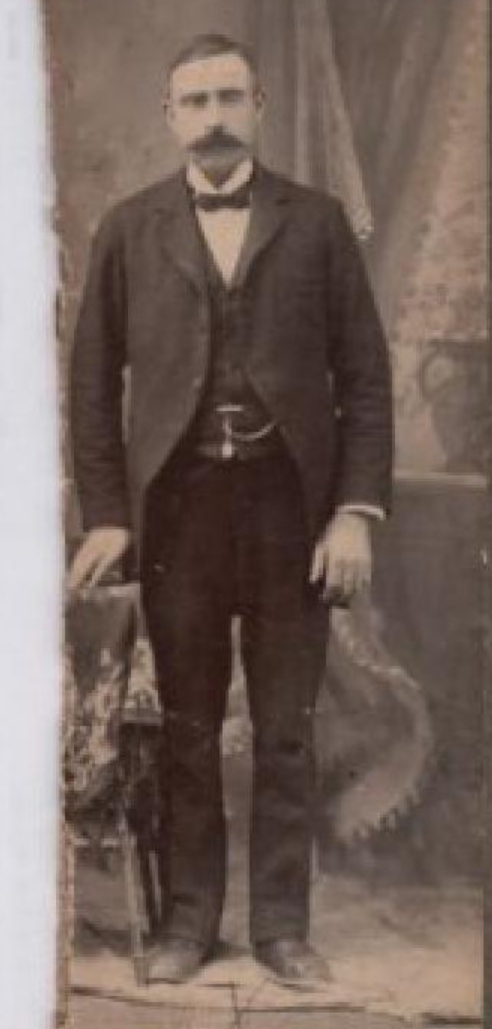 |
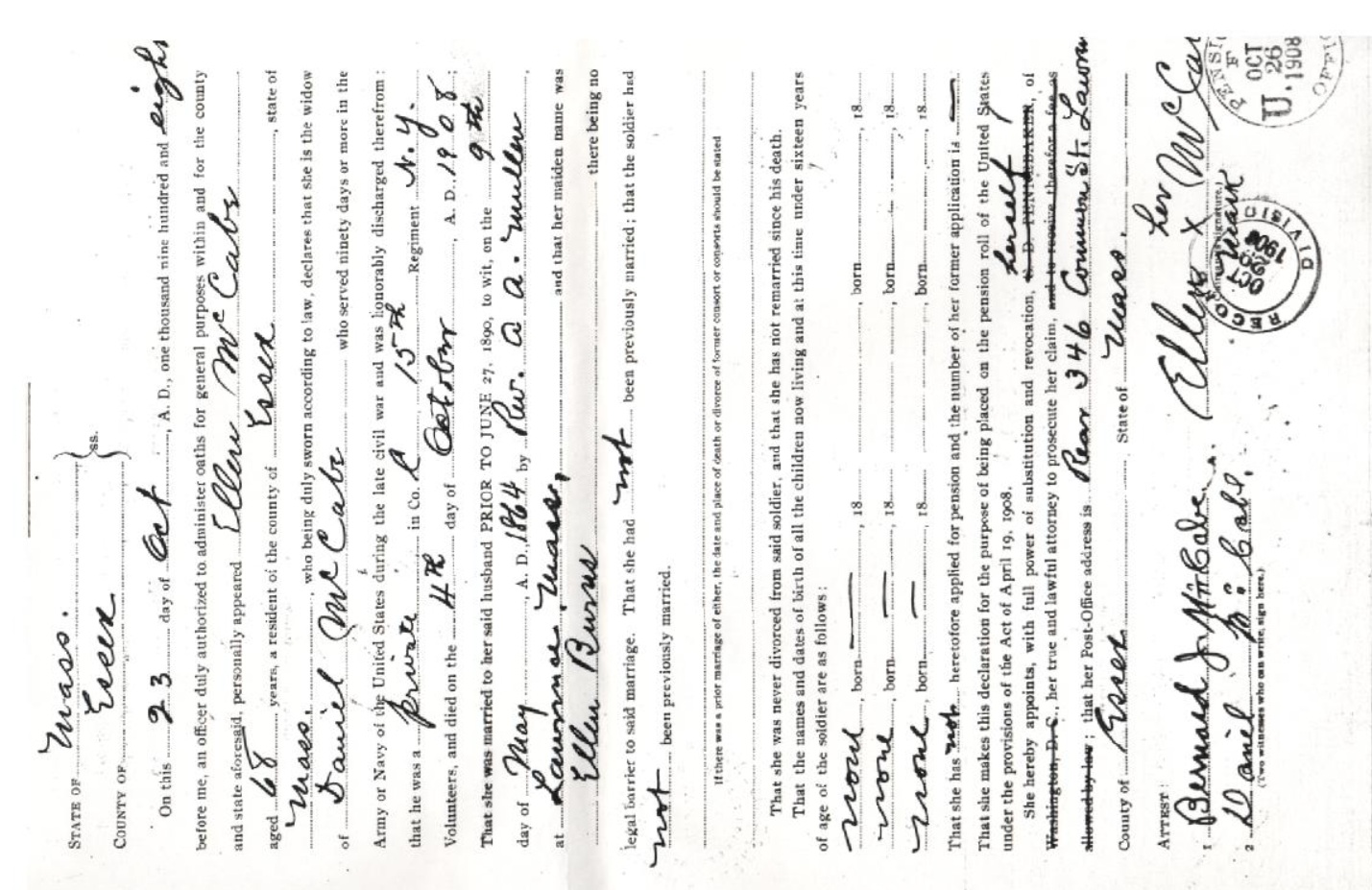
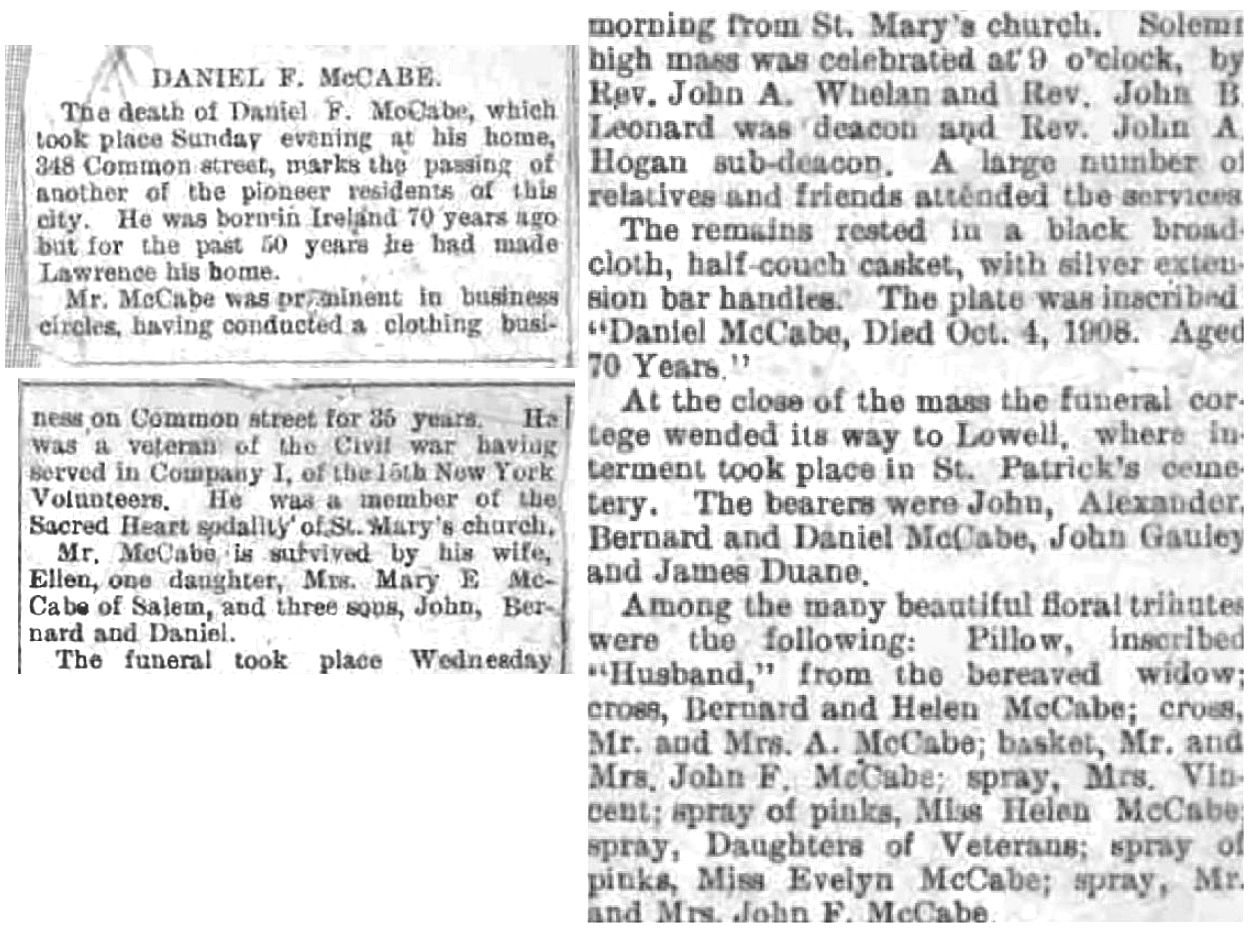
Left: Daniel McCabe circa 1885 My mother told me that her grandfather Daniel was wounded in the Civil War, that he never fully recovered from his injuries and that he showed her the scars from his wounds on his legs. Daniel applied for and received a veterans disability pension for wounds received in the Civil War. After he passed away his widow applied for the widow's pension. Ellen could neither read nor write, she signed with an X which was witnessed by her sons Bernard and Dan. The signature page of the application is shown directly below this paragraph. |
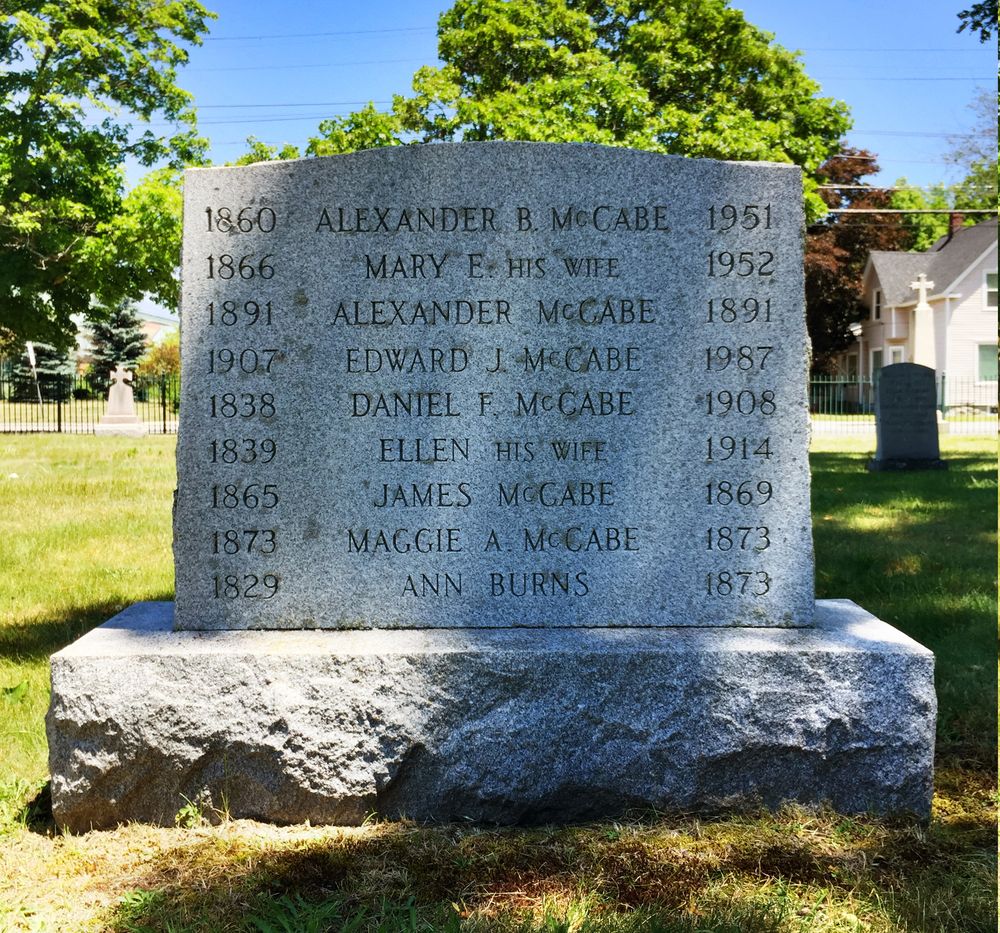 |
McCabe family headstone St. Patrick's cemetery Lowell MA |
The Irish immigrants worked hard to make their mark in America and were determined to leave a permanent record of their life and accomplishments. This may explain the rather elaborate funeral of Daniel McCabe (see previous obit entry directly above) and the grand headstone erected in St Patrick's Cemetery in Lowell MA.
This headstone was erected by Daniel's grandsons, fifty years after he was buried at this site.
 |
The Caseys of Millstreet, County Cork |
I have traced the Casey family back to Patrick Casey (1772-1870) my great-great-great-great grandfather. Could there be a more Irish name than Patrick Casey? Patrick was born in the tiny village of Emly in Tipperary County sometime in 1772. Patrick passed away in Castlereagh in 1870 at the grand age of 98. Patrick married Mary Reardon, and they had a son John Casey (1796-1870). John Casey married Ellen Leahy (1795-1805). John and Ellen had a son, Daniel (1819-1869) who married Honora Quill (1819-1880). Daniel and Honora had a son, Jeremiah (1832-1886) who was my great grandfather. Jeremiah married Julia Lehane ( Lyhane ) in 1858. | |
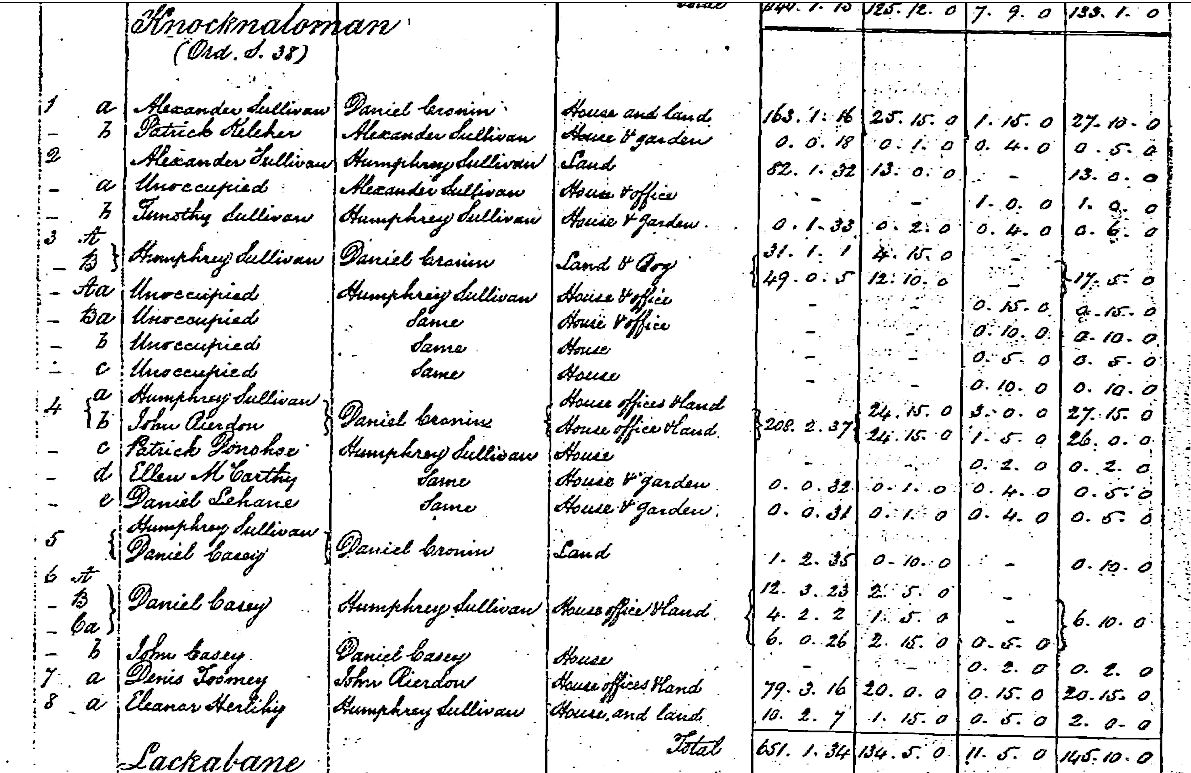 |
| This is a page from Griffiths Valuation. the document shows that Daniel Casey and Humprey Sullivan leased land...in the townland of Kocknaloman, from immediate lessor Daniel Cronin. Daniel leased additional acreage and a house and an office. The land lease involved 23 acres. This valuation was dated 30th of November 1852. Source: Report on the Casey, Lehane and McCabe Families, 25th October 2024, Timeline Genealogy in Ireland |
Significant information revealed in the Report on the Casey, Lehane and McCabe Families, 25th October, Timeline Genealogy in Ireland includes:
| From 1860, Jeremiah and Julia had their children baptised at the Roman Catholic parish of Rathmore and a number of Lehane family members stood as sponsors to the baptism, suggesting Julia Lehane had family nearby. As marriages usually took place in the home parish of the bride, Julia could have originated in the Roman Catholic parish of Rathmore. The marriage register for this parish commences in 1830 and has been indexed and digitised online. No evidence has been found for the marriage of Jeremiah Casey and Julia Lehane at Rathmore parish. However it must be noted, some sections of this register are almost illegible. Griffiths Valuation: Casey Landholding Griffith's Valuation was a nationwide survey of property holders taken between 1847 and 1864 for the purpose of assessing the rate of local taxation, which was levied for the upkeep of the poor and destitute of the parish. Since most of the census returns for the 19th century have been destroyed, Griffith's acts as a valuable mid-century census substitute. Griffith’s Valuation recorded the occupier, owner, description, size and value of the property. Research has established that Jeremiah Casey was residing in the townland of Knocknaloman in the civil parish of Drishane from as early as 1860. The townland of Knocknaloman is adjacent to the townland of Cahirbarnagh. |
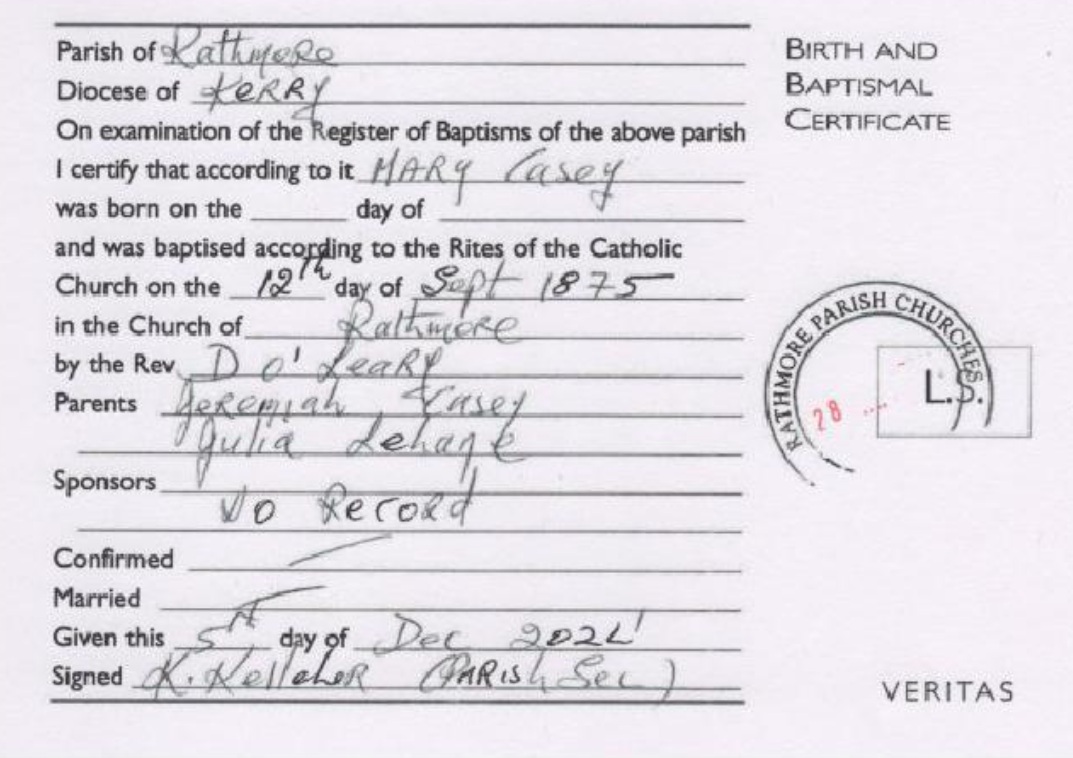
Many of the original church records dating from the 19th century are barely legible (see the genealogist's note on the previous page). The Timeline researcher found the civil birth record for Mary Casey but not the church baptismal record. Subsequently, a cousin contacted the Rathmore parish church, and the clerk furnished the document below which certifies that grandmother was baptized on Sept. 12, 1875.
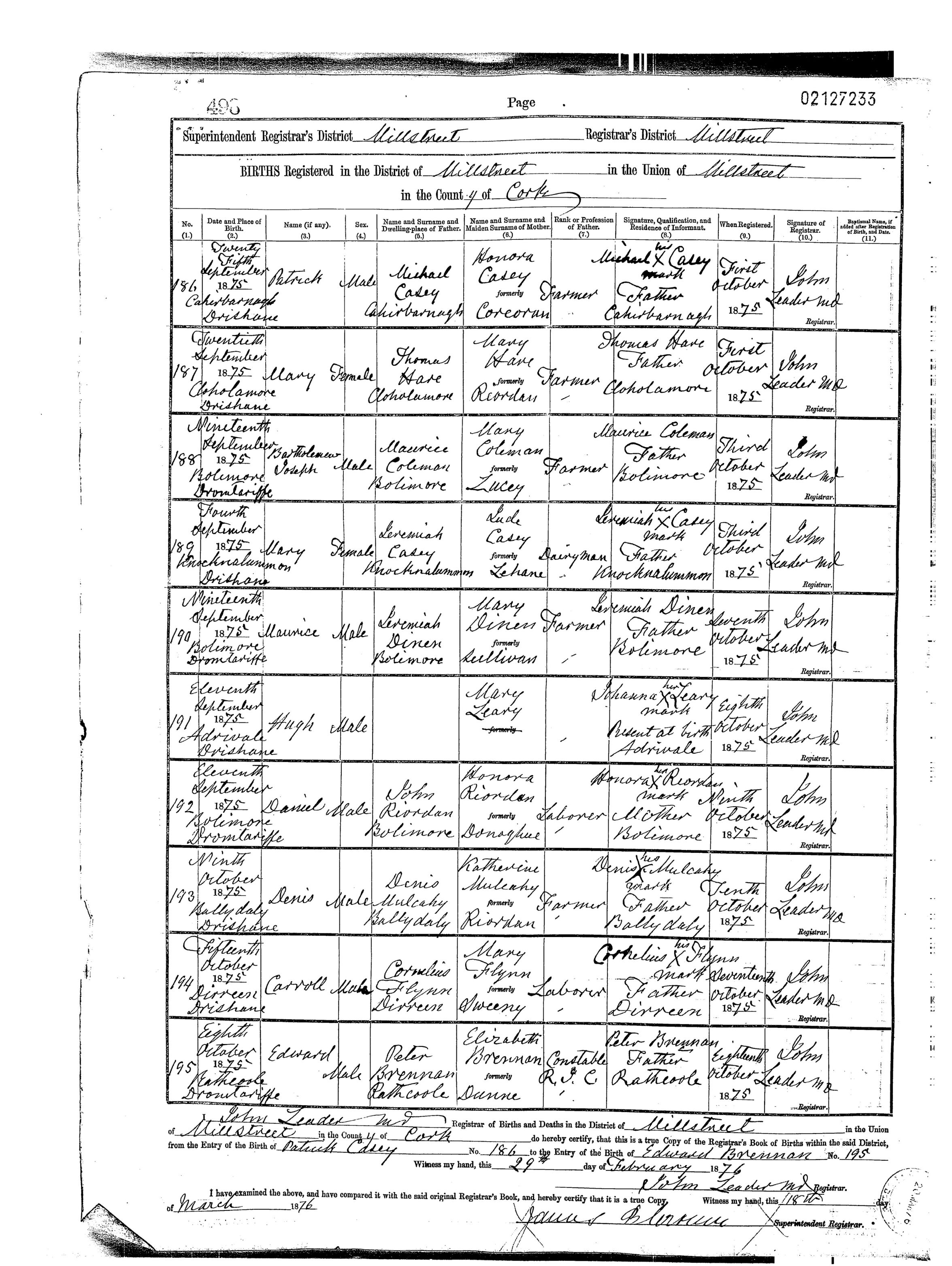 Above: This is the civil record of the birth on the 4th of September 1875, of Mary Casey. |
 |
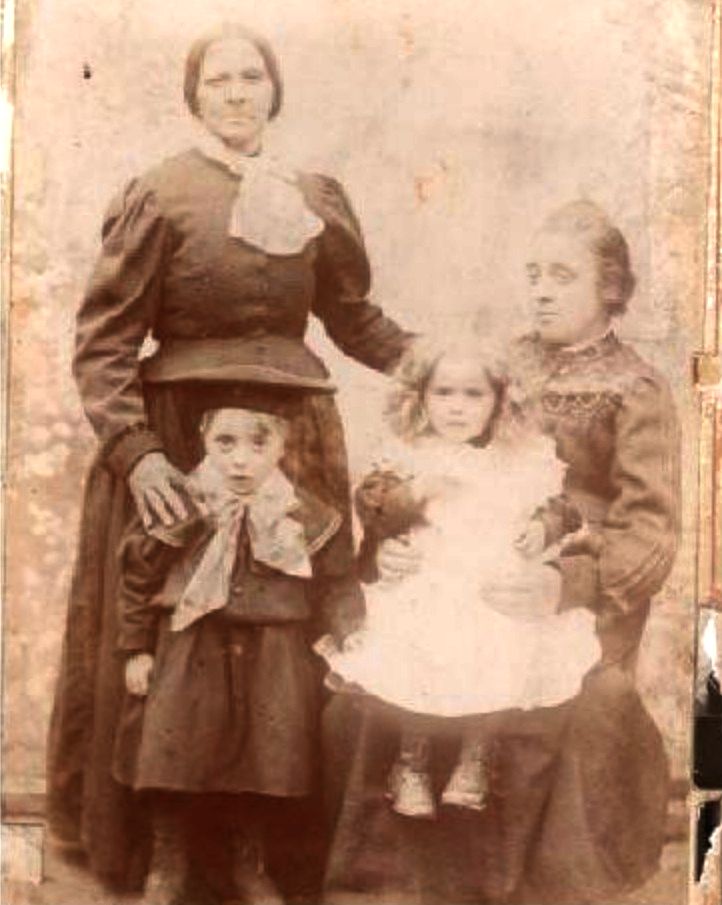 Julia Lehane Casey her daughter Nora and her grandchildren: John and Katie. |
Jeremiah and Julia had seven children and twenty grandchildren. I have literally dozens of Irish cousins on the Casey side. |
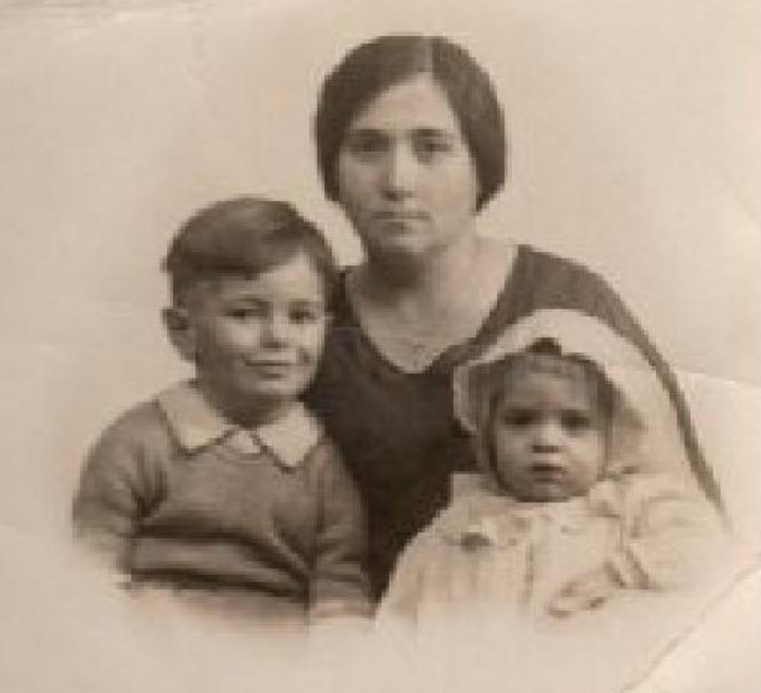 |
Abbey (Bina) was the fourth child of John and Mary Casey. She married Eddie Dennehy and they emigrated to New York. They had four children. Bina and my grandmother were close, and Bina was very close to my uncle Bernard. |
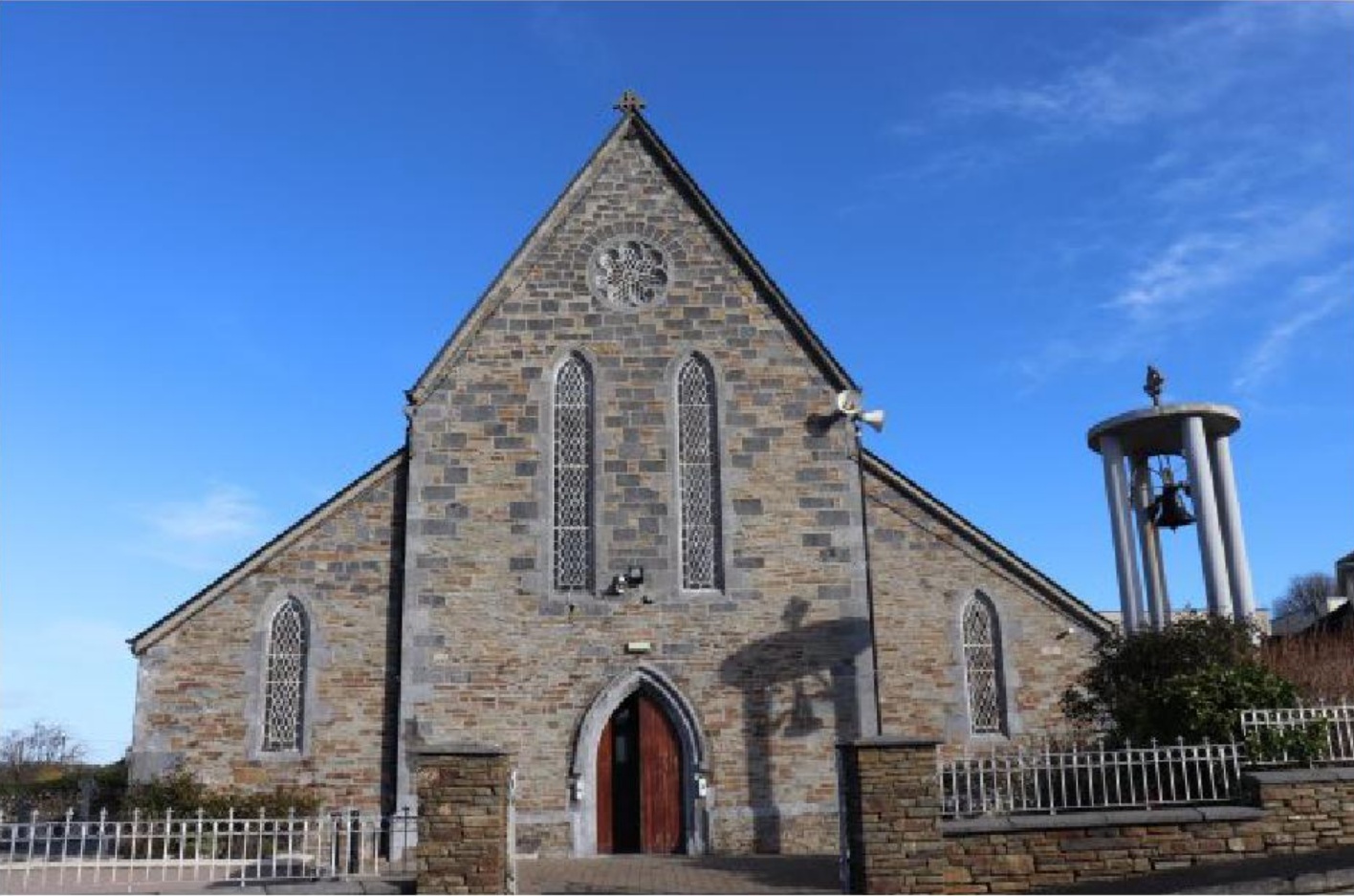 Pictured above, St Josephs Church Rathmore, County Kerry. The Casey children were baptized in this church which was built between 1860-1865 |
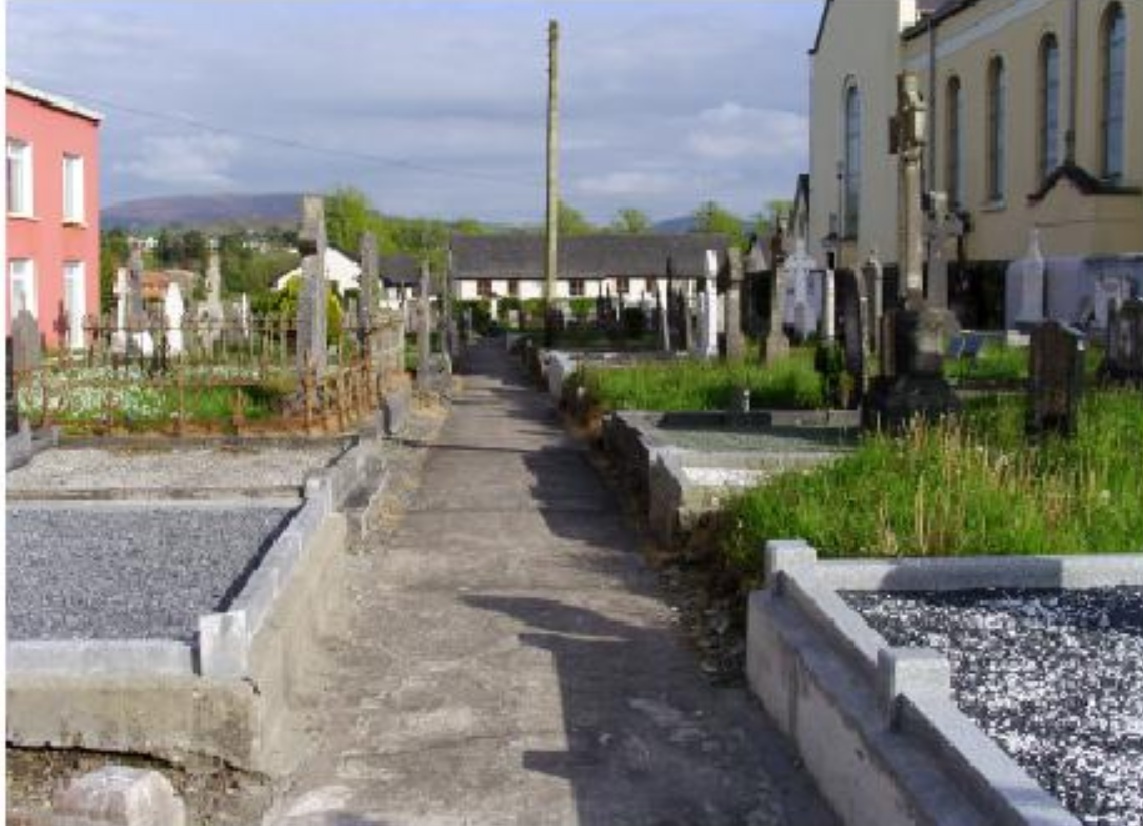 | Top left: This is St Patricks cemetery in Millstreet, County Cork. Several Casey family members are believed to be buried here although only one grave marker has been identified. In the 19th century few Irish Catholics in Cork had the money to pay for a grave marker |
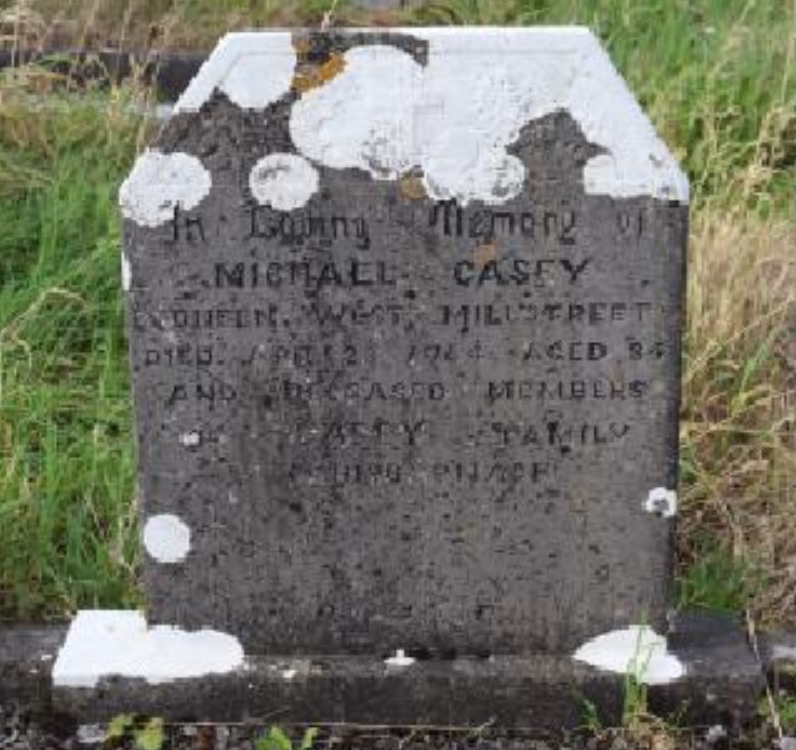 | Bottom left: This is Michael Casey's headstone. The inscription reads "In Loving Memory of Michael Casey, Dooneens West, Millstreet. Died Apr 23, 1964. Aged 84 and deceased members of Casey Family". Michael Casey was a grandson of Jeremiah Casey. Jeremiah was likely buried at this site |
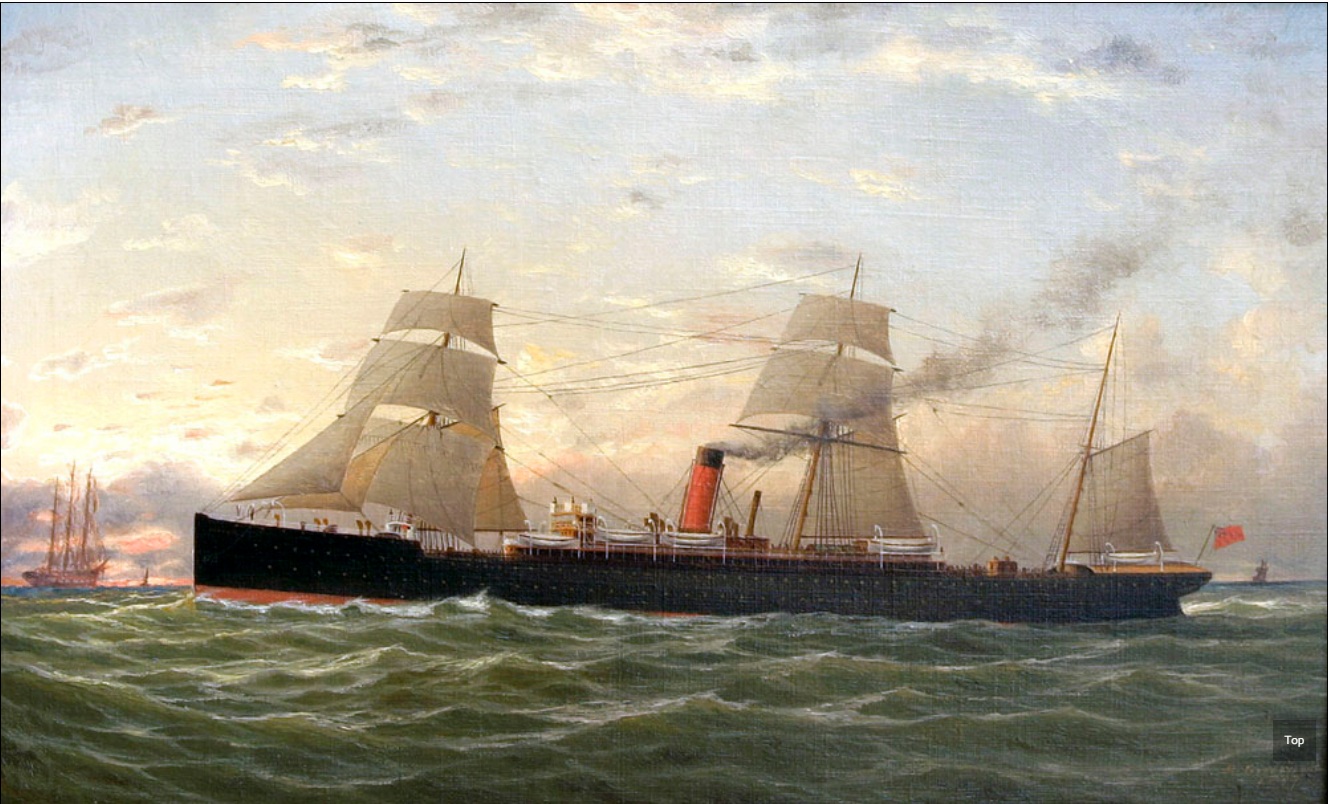 SS Pavonia
|
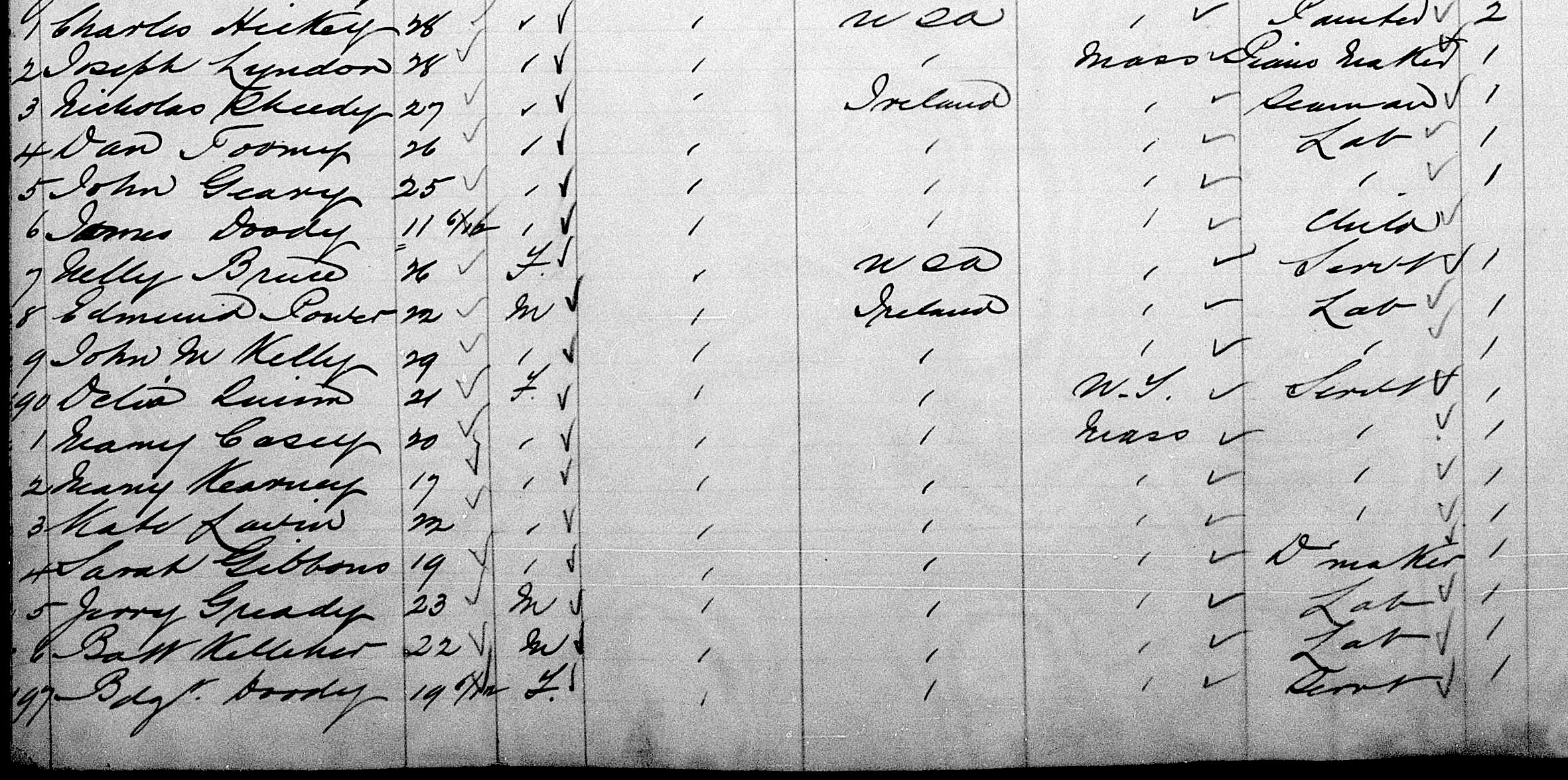 This is the passenger list for the pavonia arriving in Boston on May 7, 1895. Mary Casey is shown on the 7th line from the bottom. Left click anywhere in the above Manfest image to get a full size view of the original passenger ship listing...after viewing left click the return arrow (←) to return to this page |
 |
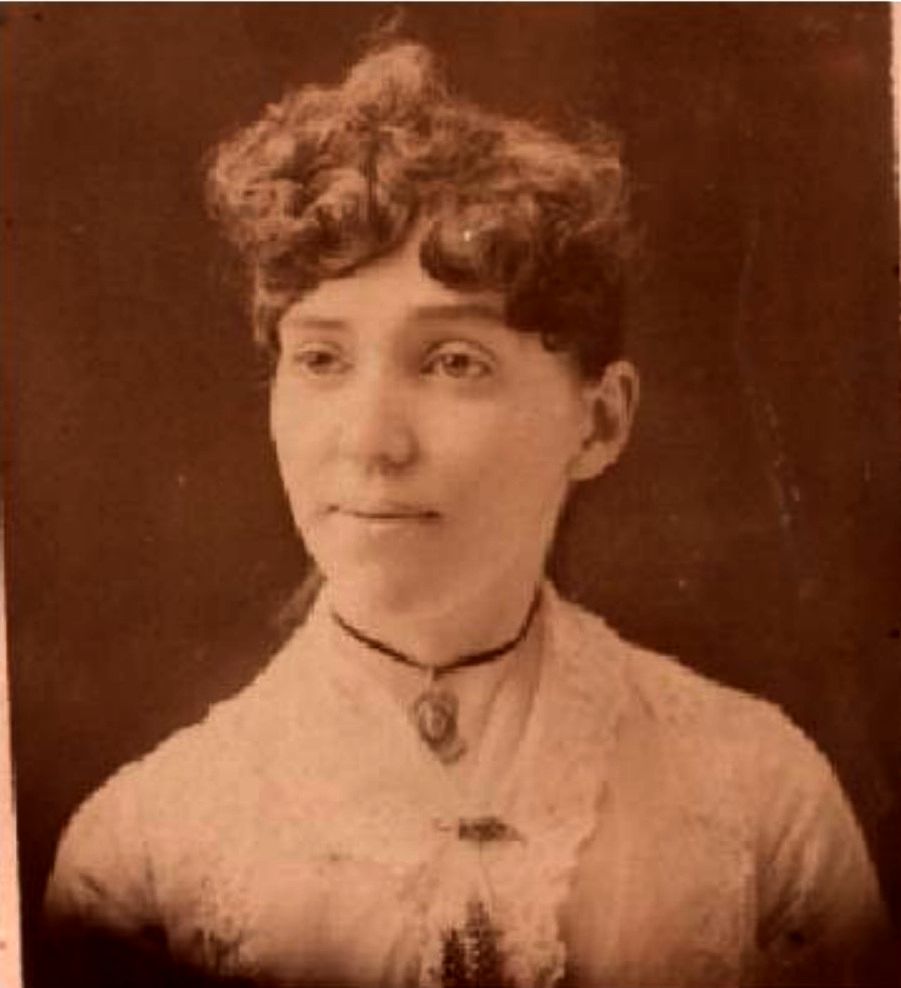 Mary Casey circa 1900 |
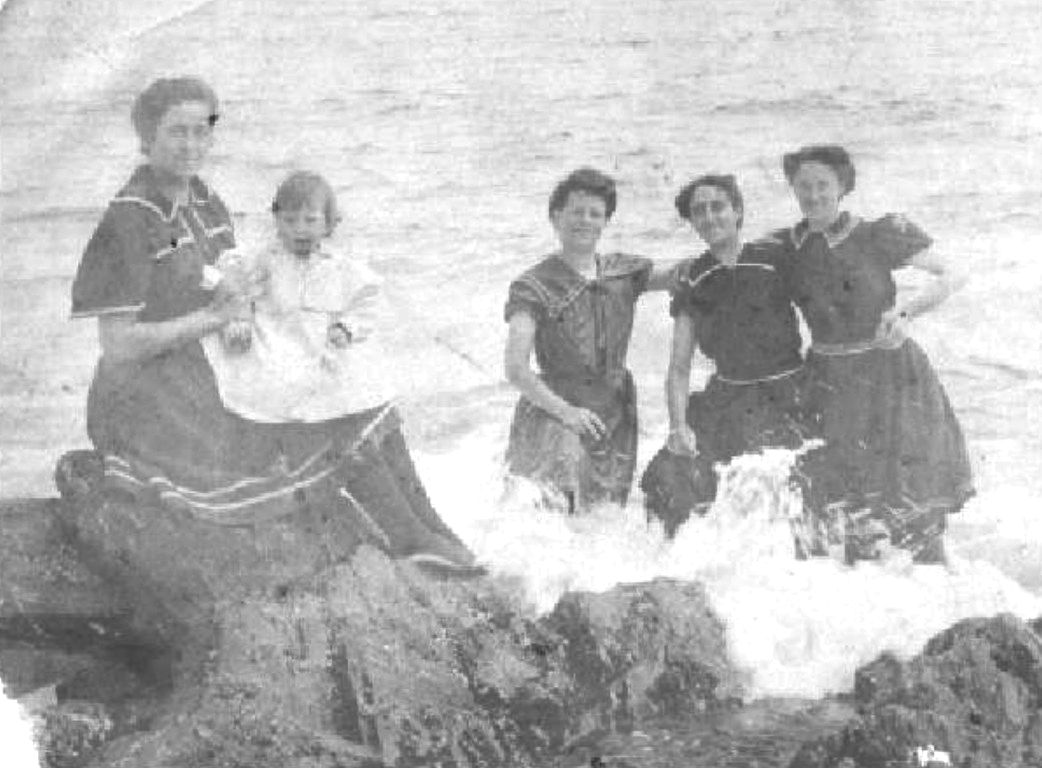
Mary Casey was unmarried for the first several years that she lived in Lawrence. It was likely that she lived in a boarding house with other single women and had a circle of friends who worked in the mills or as household servants. They likely worked six days a week and had Sunday free. On their off day they would travel together to the beach (Salisbury MA or even Hampton Beach NH). There was a well-developed trolly system that serviced the Merrimack Valley mill cities and the beaches. Professional photographers would be available to take pictures for a small fee. | |
| Source: Lawrence MA Historical Society | |
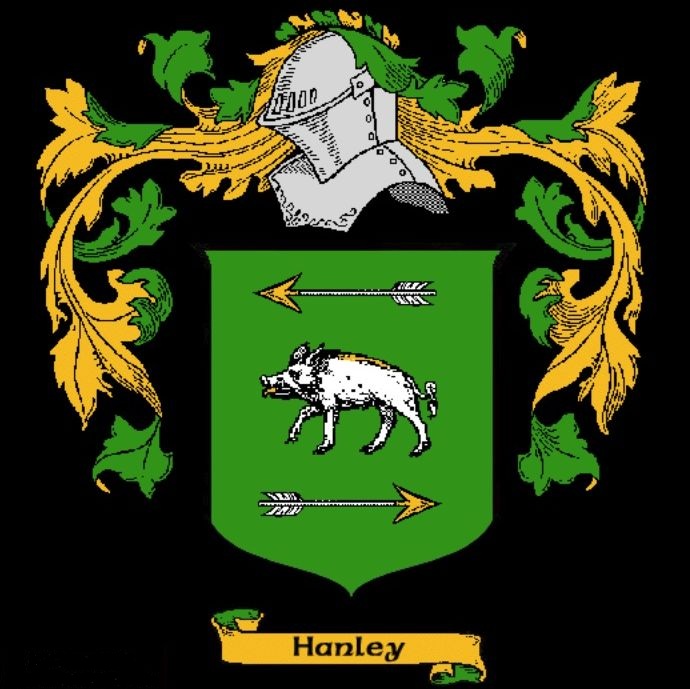 | The Hanlys of Labbamologa, County Cork |
Thomas and Margaret Hanly were my great great grandparents. They were married on the 5th of March 1821 and would go on to have 5 children: | |
| |
| Research Results 1766Cloyne Diocesan Census In 1766 a resolution was passed in the House of Lords directing the archibshops and bishops to request parish ministers to return a list of families in their parish, distinguishing the Protestants from the ’Papists’ [Roman Catholics]. Most of the returns were made in March and April 1766. Few of the Diocesan census returns sirvive, however, many of them were transcribed and copied. A transcribed copy survives for the Diocese of Cloyne, in which Labbamolaga is located. The transcript of the 1766 Cloyne Diocesan Census was made by Rev. Robert Brown in 1904, prior to its loss in the 1922 Public Record Office fire. A copy of Brown’s transcript is available through the Virtual Record Treasurey of Ireland and the original is available in the Nation Archives of Ireland (NAI PRIV/M/5036/A). This transcript was inspected for the parish of Templemologga. The 1766 Diocesan Census recorded two Protestant heads of household in the parish of Templemologga: William Anderson and John Morgan. The ’Papists’ Catholics in the parish were also listed. They amounted to 110 men, heads of household. Unfortunately, none were named Hanley/hanly. The following were the surnames recorded: Gafahane, Ryan, Henessy, Shine, Regan, Bowler, Mize, Connell, Brien, Herbert, Riordan, Carthy, Callahan, Welsh, Diviane, Malachy, O’Donnell, Guiry, Kenny, McNamara, Tobin, Ronayne, Lee, Casey, Dun, Keefe, Keane, Omdaly, Line, Dun, Guider, Quane, O’Neal,Carey, Cleary, King. Donovan, Morrissy, Glaveene, Meagher, Flin, Cantlan, Condon, Meade, Dogherty, Halloran, Leahy, Clifford, Mara Murphy, Whelan, Currane, Heffernan, Fox, Tobin, Sulivan, Coleman, Cotter, Egan, Spilane, Shanahan, Malacat, Tracey, Norry, Collins, Colis, Hartigan, Carrol, Gaffahan, Guinan, Condon, Broderick, Donegan. The name Hanly was found in the Town of Charleville, where a John Hanly was enumerated. Perhaps more relevant is the Thomas Hanly who was enumerated as a Papist in the civil parish of Kildorrery. Kildorrery is adjacent to the civil parish of Templemolaga |
I tasked our consulting genealogist with finding the early generations of Hanlys and they reported on their research on 13 February 2025. A major finding in this research effort is that a Thomas Hanly was found in Kildorrey in the 1766 Cloyne Diocesan Census. Thomas may have been the grandfather of my great great grandfather Thomas who was born circa 1800. The name is right, the location is right, and they were all "Papists". Also, the first report on the Hanlys demonstrated a close connection with the Roman Catholic parish of Kildorrey. |
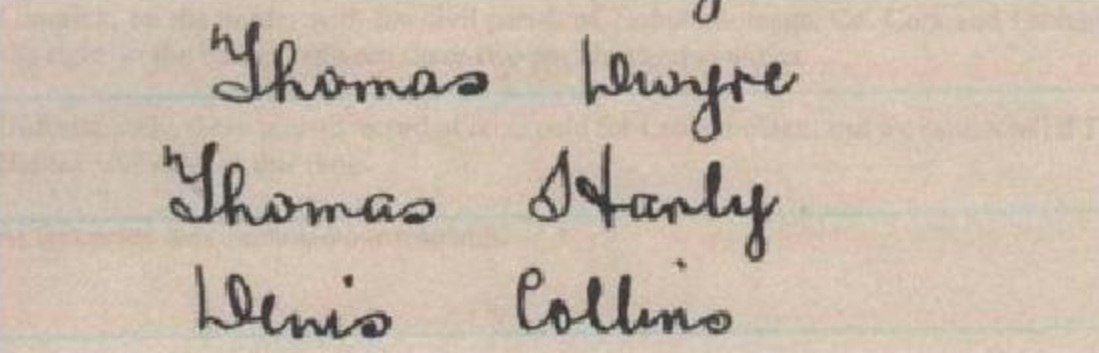
Unfortunately, the census does not provide a townland addresses for each family. |
What this research effort shows is that there were many branches of the Hanly family living in the adjacent parishes of Templemolaga and Kildorrery in County Cork from at least the 1760s. Great great grandparents Thomas and Margaret Hanly were married at the Roman Catholic parish of Kildorrery and all of their children were baptized in that parish. |
Married at the Roman Catholic Parish of Kildorrery on 5th March 1821, Thomas and Margaret Hanly Labamolloga, present Michael and Bridget Hanly Left click anywhere in the above image to get a full size view of the original marriage record...after viewing, left click the return arrow (←) to return to this page This couple married in 1821. Since the baptismal register for the Roman Catholic parish of Kildorrery began in 1824, it is possible that James had older siblings, and their baptismal records may not have survived. |
James (1827-1908) married Catherine Dunne (1850-1879) on Feb 22, 1870 at the Roman Catholic parish of Galbally and Aherlow. Catherine died when John (my grandfather) was six. John lived on the family farm, with James and Mary Moloney, James second wife. John left Ireland at age 19 arriving in Boston on June 5, 1892. He sailed on the SS Pavonia from Queenstown. Ironically, Mary Casey, my maternal grandmother would sail on the Pavonia and arrive in Boston four years later. |
| Thomas Hanly was a tenant farmer on the estate of the Earl of Kingston. Review of land records shows that Thomas was a leaseholder from the early 1820s. The landlord-tenant system in Ireland was particularly cruel. The landlords, many of whom were granted peerages by the British crown, lived privileged lives in their grand country houses. The tenants lived in thatched huts (we have a document that states that Margaret Hanly was living in a thatched cottage) and scraped out a living on a few acres. | Height: 6 feet Number of Measures: 33 Rate per measure: 3 ½ Amount: 9s. 7d. 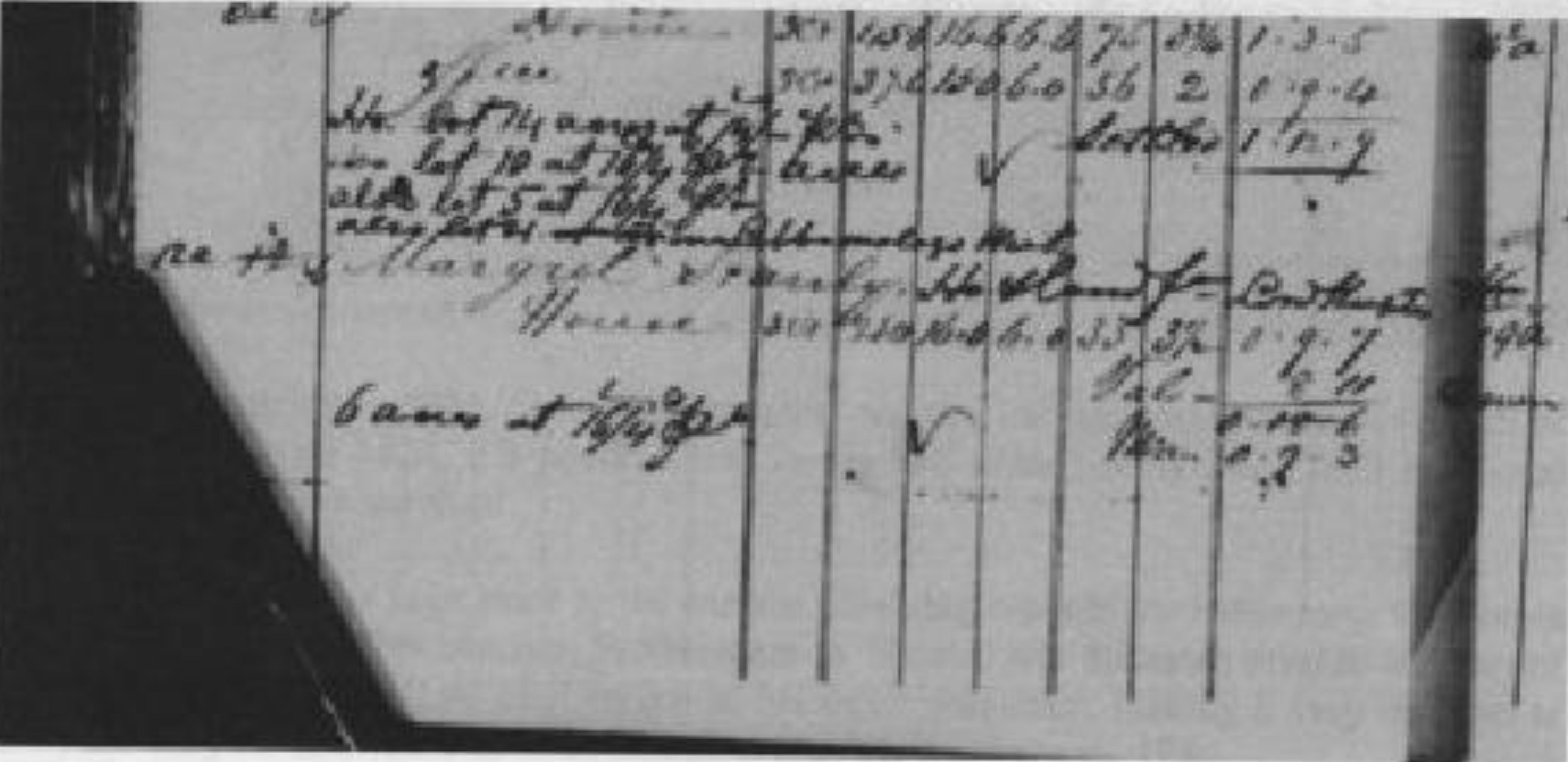 Left click anywhere in the above image to get a full size view of the original Griffiths field book...after viewing, left click the return arrow (←) to return to this page The search also uncovered two additional Hanly/Hanley households listed in the Valuation Office Books for Labbamolaga, Patrick Hanly at Lot 14Aa and Thomas Hanly at Lot 3a. Tithe Applotment Books A search of the digitised and indexed Tithe Applotment Books, available online through the National Archives of Ireland’s genealogy website, was conducted for evidence of the Hanley family landholding in the townland of Labbamolaga Middle. The search retrieved a copy of the Tithe Applotment Book for Labbanmolaga in the civil parish of Templemolaga, dated 1826, which recorded four Hanley households in total. By the time the Valuation Office House Books were compiled, the townland had been rearranged, making it unclear which of these Hanley households corresponds to the landholding of Margaret and James Hanley at Lot 12a in the Valuation Office House and Revision Books. However, James’s marriage record to Mary Maloney in 1879 confirms he was the son of Thomas Hanley, a farmer. Given that James was born around 1831, his father, Thomas, may have been leasing land ca. 1826. While it is not certain, it is plausible that the Thomas Hanley recorded in the Tithe Applotment Books was James’s father. Thomas Hanley leased 13 acres, 3 roods, and 2 perches of land in the townland of Labbamolaga and paid an annual Tithe of 6s. 10d. |
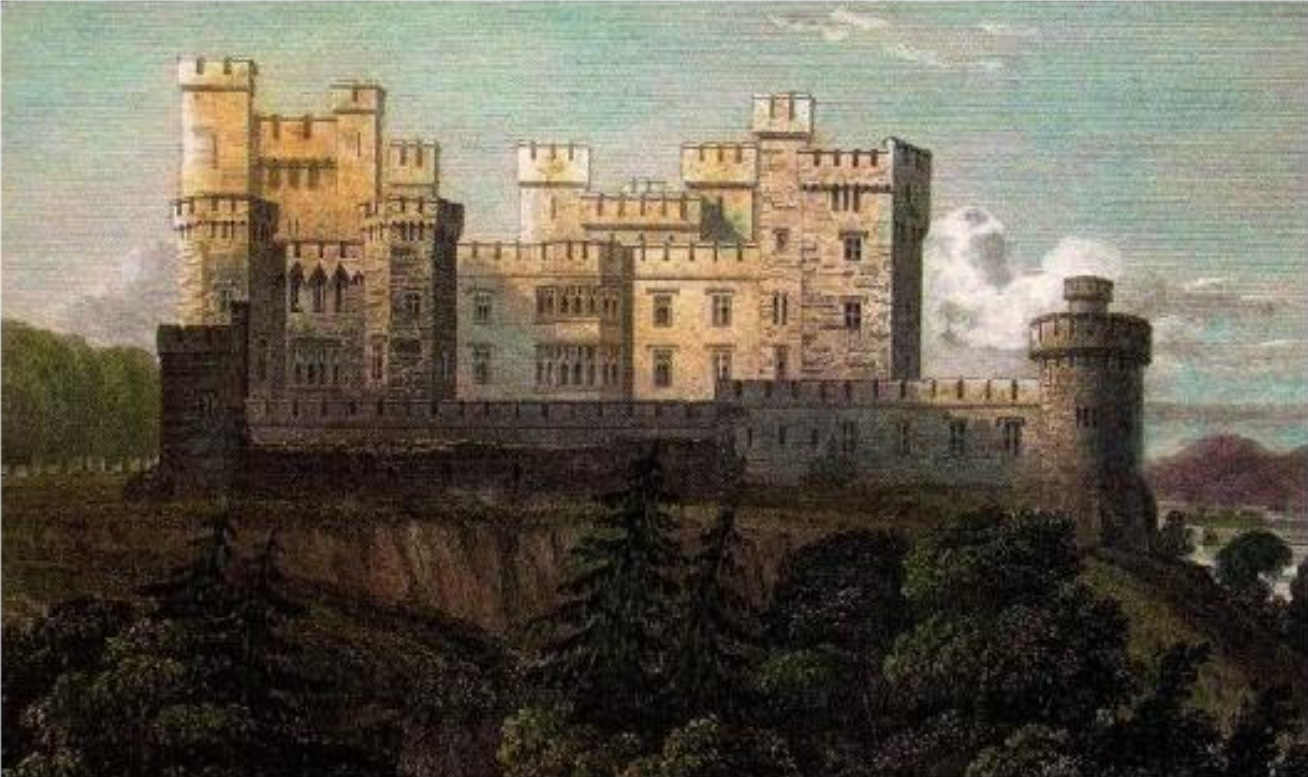 |
Mitchelstown Castle was built in 1823 to be the largest house in Ireland. It was home to the 3th and 4th Earls of Kingston. The castle was occupied in 1922 by the Irish Republican Army and on 12 August 1922 it was burned on the orders of a local Republican leader. |
The 3rd Earl of Kingston built a royal suite in the castle and invited King George IV to visit. The King never showed up and no one ever spent a night in the royal suite. The Earl’s family had a reputation for brutality and in the 1880s there was an incident where several men were shot by members of the RIC (Royal Irish Constabulary) in Michelstown for protesting working conditions on the estate. The executions, the evictions, the indifference to the plight of the poor during the Famine, all played a part in the festering rage of the tenant class which exploded during the Irish War of Independance and the Irish Civil War that followed. During the Civil War over 300 country manors were burned. Recommended reading: Wikipedia: Mitchelstown Castle and rte.ie: 13 August 1922: The destruction of Mitchelstown Castle | |
Lot 12 in the townland of Labbamologa Middle is located on the following Valuation Office Union Map, which dates from the 1880s and 1890s: 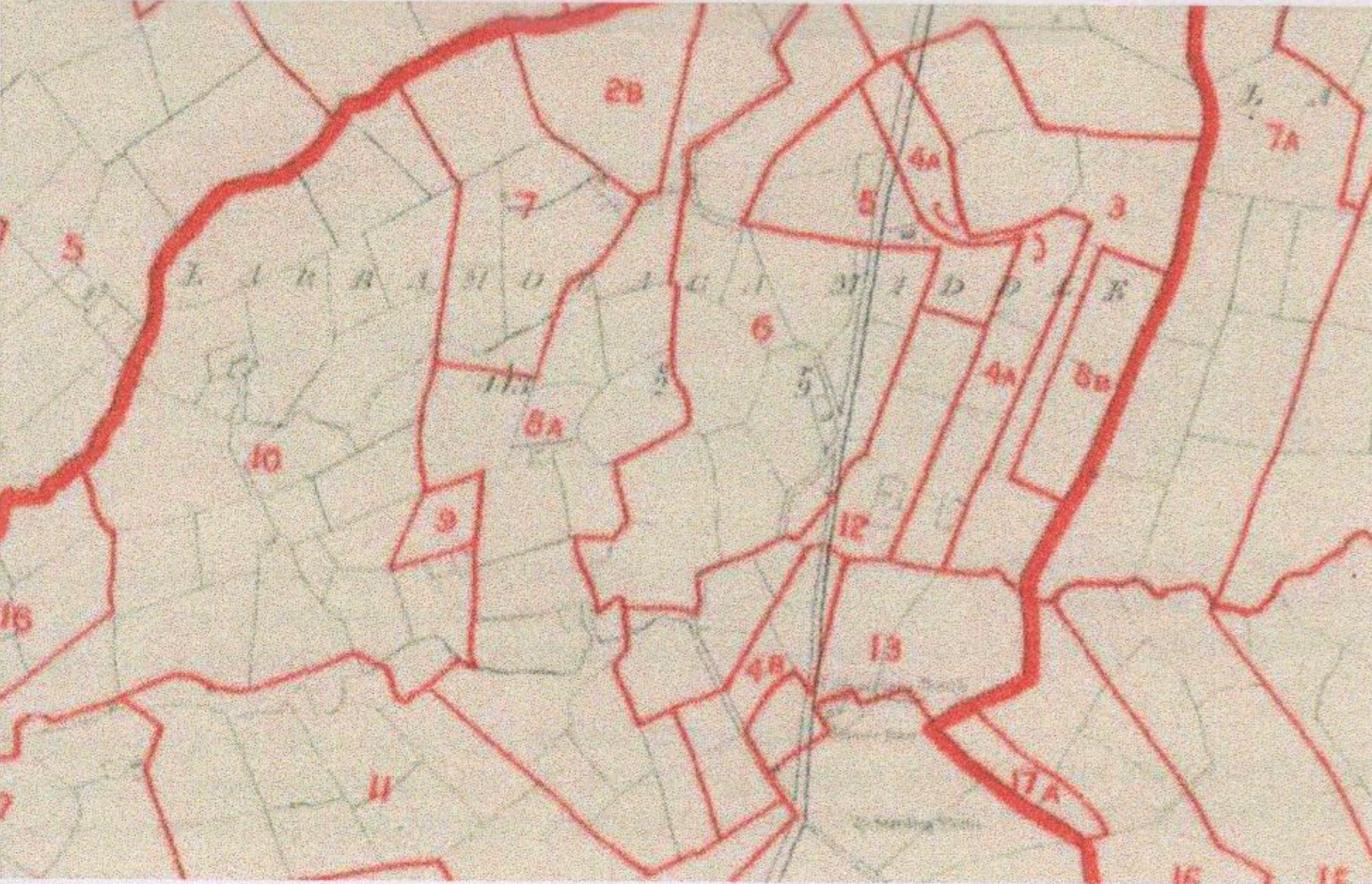 Lot 12 is above the ancient graveyard. This was the home of the Hanley family from at least the 1830s into the 20th century. |
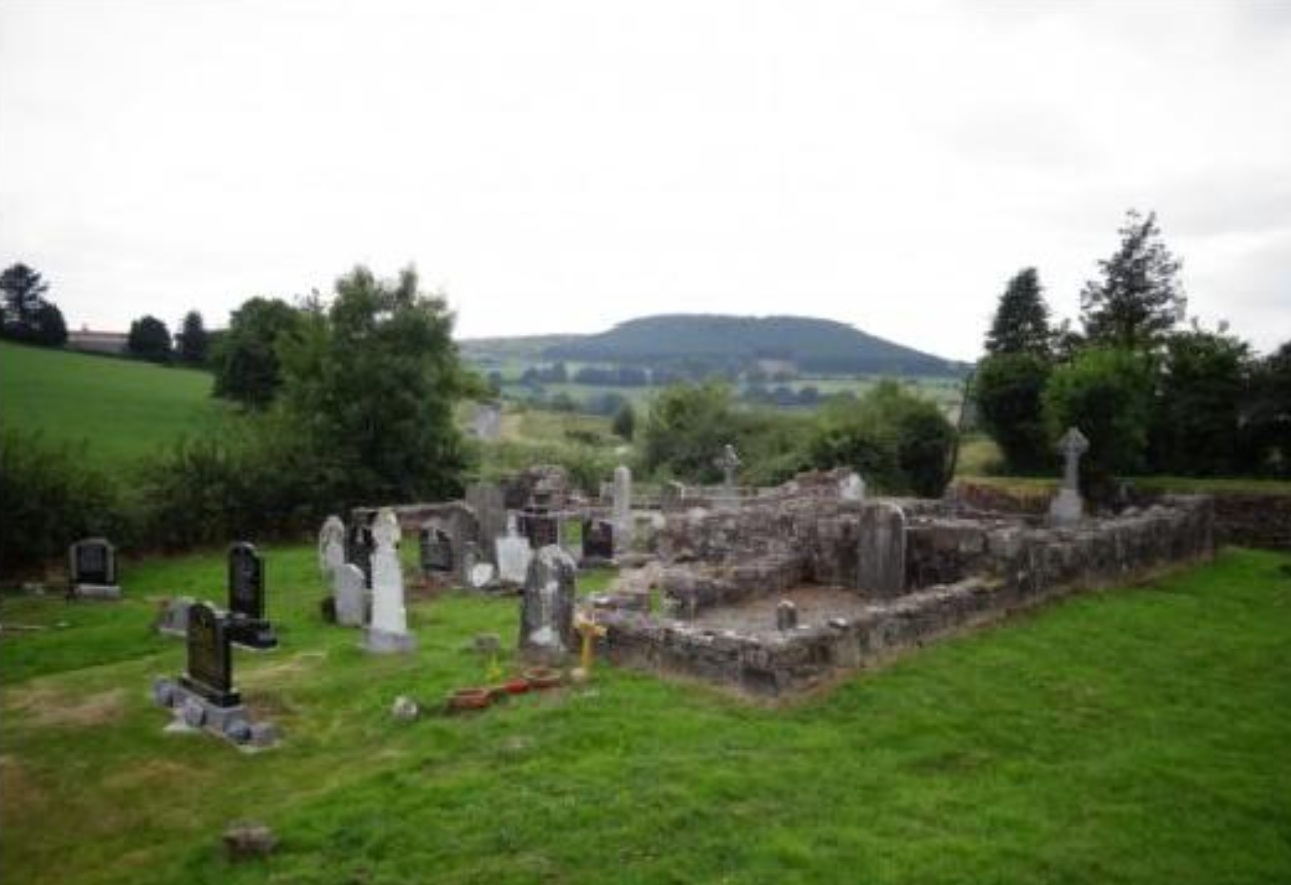 |
Labbamolaga ( "Leaba Molaga" means bed or grave of Molaga ) is a national monument of Ireland and the site of an ancient stone formation dating to the Bronze Age. In the 7th century AD Saint Molaga founded a church and monastery here. The church was ruined by the 16th century. Source: Early Christian Sites in Ireland |
Family lore has it that the Hanlys have lived and farmed in this part of Ireland for more than seven hundred years. We have documentation that the Hanlys were present in the area from the 1760s and they leased land near the ancient site from as early as the 1820s into the 20th century. Several Hanlys are interred at the Labbamolaga cemetery which is on the site of the ruins of the ancient church and monastery. It is likely my great grandparents James and Catherine were buried at Labbamolaga. | |
| I'm not certain when Hanly changed to Hanley but in all of the 19th century documents the name is spelled without the e. On the SS Pavonia passenger's ship list, grandfather's name is spelled Hanley. A land record dated 6th July 1850 states that Margaret Hanly was the occupier of Lot 12a (click HERE to view the Griffiths map) in the townland of Labbamolaga Middle, so Thomas had passed prior to that date. We do not have a record of his death. |
The following details were extracted from the Valuation Office House Books Valuation Office House Book, thth July 1850, the townland of Labbamolaga Middle Lot 12a Margaret Hanley House Quality letter 3C+ meaning she occupied a thatched house, with stone walls with mud or puddle mortar, dry stone walls pointed or mud walls of the best kind, that was 50 years of age or older, but in good repair. Length: 21 feet Breadth: 16.0 feet Height: 6 feet Number of Measures: 33 Rate per measure: 3 ½ Amount: 9s. 7d. |
Review of the records indicate that James Hanly took over occupancy of Lot 12a in 1870 and the genealogist found a record of the death of Margaret Hanly on St. Patrick's Day, the 17th of March 1869. The death was registered by her son, James. |
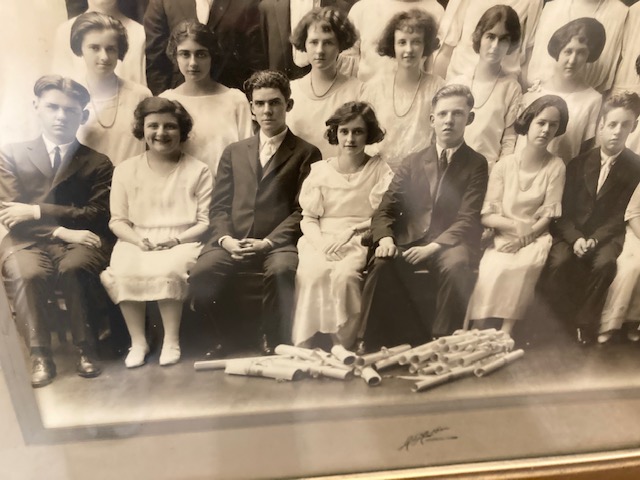 St. James senior class My dad seated front row far left, Aunt Mary seated front row second from right 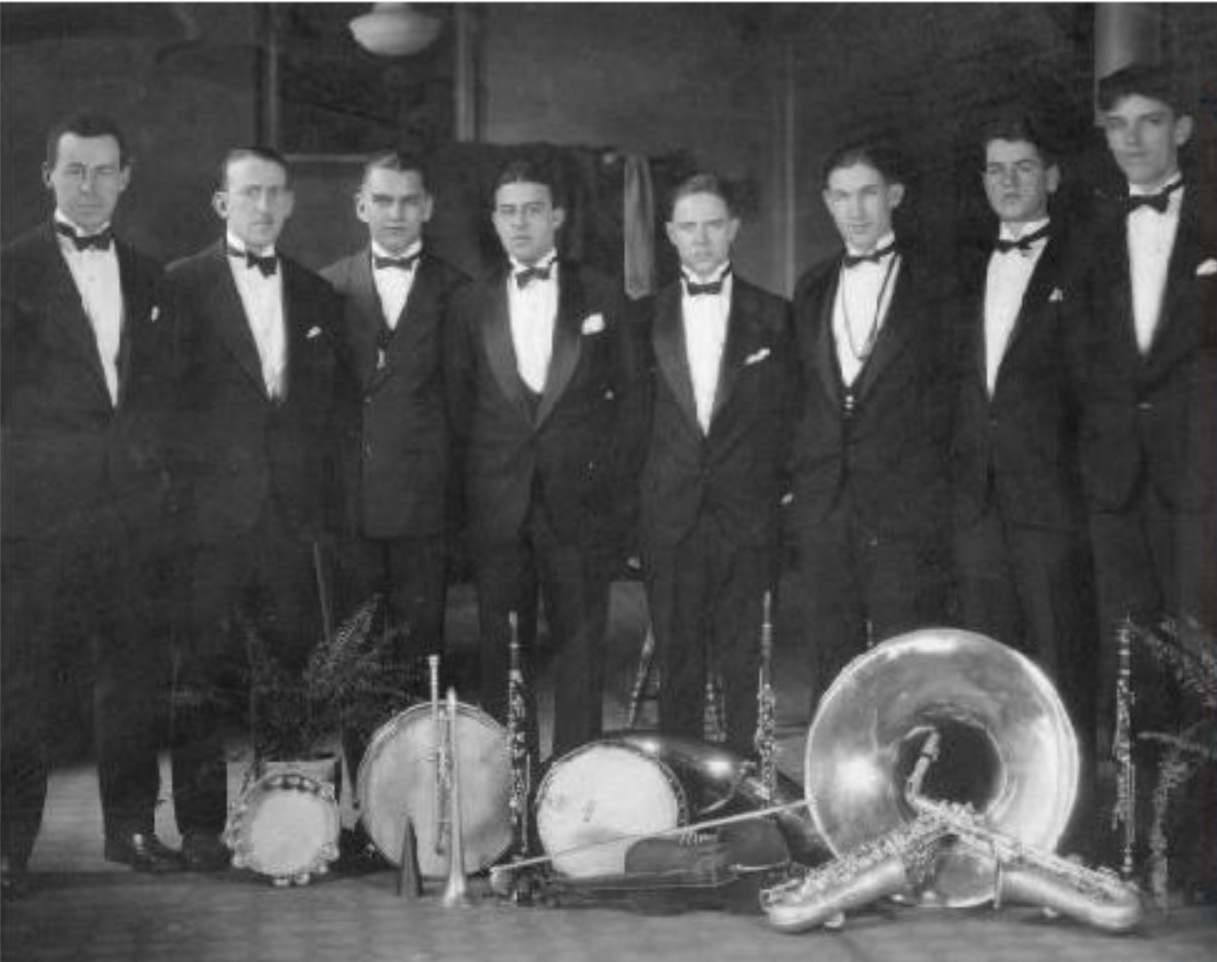 Villanova Concert Band 1924 Jim Hanley, second from right 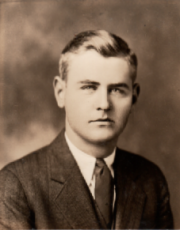 Dad, circa 1932 Mary Fallon (1871-1952) my paternal grandmother was the daughter of Michael Fallon and Catherine O'Donell. John Hanley and Mary were married on Oct 7, 1903 and lived their entire lives in Haverhill, MA. They raised three children, James, my dad, and my aunts, Mary and Margaret. James (Jim) and his sister Mary graduated in the same class at St. James High School in 1922. Afterwards dad attended Villanova College for two years. He studied electrical engineering and played the coronet in the concert band. I'm uncertain as to why he did not finish Villanova, family finances perhaps? After Villanova, he was employed as an accountant. |